


A home buyer rebate is when a real estate agent or broker gives back a portion of their commission to the buyer at closing as cash, a closing credit, or even a gift.
Not all agents or brokers offer home buyer rebates, and home buyer rebates are banned in Alabama, Alaska, Kansas, Louisiana, Mississippi, Missouri, Oklahoma, Oregon, and Tennessee. But if you buy a home in a state where home buyer rebates are allowed, you could potentially save a significant amount of money going through an agent or broker who offers one.
You can negotiate a home buyer rebate with your real estate agent or use a real estate company that already offers home buyer rebates or cash rewards as a built-in benefit. For example, Clever Real Estate matches you with top local buyer's agents so you can interview and choose the best agent for you. Plus, eligible buyers can qualify for Clever Cash Back (up to $500) after closing.
💰 Buy with a top local real estate agent and qualify for Clever Cash Back. Fill out this quick form to get free matches with the best Clever agents in your area!
How do home buyer rebates work?
Key takeaways
- Most agents and brokers offer home buyer rebates as closing credits, which are subject to numerous terms and restrictions.
- Some companies, like Clever Real Estate, offer cash rewards, which are typically guaranteed in full if you’re eligible and can be spent however you want. They are usually paid out after closing.
- Home buyer rebates and cash rewards typically cannot be used to fund your down payment.
- Home buyer rebates are not considered taxable income by the IRS.
- Home buyer rebates are currently legal in most U.S. states.
How to get a home buyer rebate
If you’re looking to get commission rebate, you have three primary options:
- Try to negotiate a rebate yourself
- Hire a discount broker that offers built-in rebates
- Work with a service that negotiates rebates for you
Convincing an agent to give you a home buyer rebate isn’t easy
If you’re looking to buy with a top real estate agent or brokerage — and they’re not already offering a rebate — you may have a hard time negotiating one on your own.
The best agents are in high demand and won’t be eager to lower their rates unless there’s a compelling reason to do so — e.g., it’s a high-value purchase, you’re already ready to submit an offer, etc.
Many discount brokers offer built-in rebates — but may skimp on service
If you buy with a discount broker like Redfin, you may be eligible for a buyer rebate — no negotiations required. However, rebates can discourage some agents from working with you because they directly reduce their commission — essentially their paycheck for helping you buy a home.
Think of it like being asked to do the same job for less pay. Most people wouldn’t be as motivated to go the extra mile if their employer suddenly cut their salary, and the same logic applies to real estate agents. Some may still provide excellent service, but others might be less responsive or less willing to negotiate aggressively on your behalf.
Discount real estate brokers are worth exploring, but shop around for the best combination of service and savings. As a buyer, you’re a hot commodity to an agent or broker! You'll likely be able to find comparable rebates without compromising on service.
Some free agent-matching services offer built-in rebates and cash back
The third option is to find your agent through an agent matching service that offers built-in rebates or cash rewards.
The best agent-matching services for buyers:
- Are 100% free to use
- Only work with top-rated, full-service agents
- Offer built-in rebates or cash back (in states that allow them)
- Offer ongoing Concierge support throughout your entire purchase
Importantly, not all agent-matching services offer built-in rebates or cash back for buyers. When evaluating services, make sure you understand exactly what you’re getting — and what you’re not.
Where are home buyer rebates available?
Home buyer rebates are available and legal in 42 states and Washington, DC—though some states put limitations on what form they can take and how large they can be.
States that don’t allow home buyer rebates
As of August 2024, these states have banned home buyer commission rebates: Alabama, Alaska, Kansas, Louisiana, Mississippi, Missouri, Oklahoma, Oregon, and Tennessee.
However, there are a few exceptions. Although most of these states don’t allow any type of gift to incentivize consumers, Alabama allows certain types of incentives or gifts if all parties involved are notified. If someone promises you an incentive or cash back in Alabama, check with your lender to make sure it's allowed.
Another interesting case not on the list is Iowa, where they only allow buyer rebates in dual agency transactions, which is when one agent represents both the buyer and the seller in a transaction.
The U.S. government supports home buyer rebates
It’s worth mentioning that the U.S. Department of Justice (DOJ) supports making rebates legal in all 50 states.[1] The DOJ considers prohibiting, restricting, or discouraging commission negotiations a violation of established antitrust law — and actively investigates any organization attempting to do so.
Pay attention to how companies advertise home buyer rebates
You may see home buyer rebates or cash refunds advertised in a few different ways:
- A percentage of the home's purchase price
- A percentage of your agent's commission
- Cash back that you get after closing
When the rebate is based on commission, your buyer rebate will be limited to your agent's half of the total real estate commission fee. When you get cash back after closing, you'll typically receive a separate check that's not related to your agent's commission.
So, sticking with our 5.70% total commission rate, a 0.5% rebate of the final purchase price translates to roughly one-sixth of your agent's 2.82% commission.
📊 Savings breakdown on a 0.5% home buyer rebate
Let’s say you purchase a home for $350,000. For the sake of simplicity, we’ll say each realtor charges 3% commission fee and set a total commission rate of 6%, which translates to $21,000.
Your agent and the seller’s agent agreed to split the total commission 50/50 — so each net approximately $10,500 on the sale.
When you signed up with your agent, they promised to refund you 0.5% of the purchase price after the sale.
Assuming your lender approves the full amount, that would put about $1,750 back in your hands at closing — approximately one-sixth of what your agent earned on the purchase.
⚠️ An important note about commission credits
Typically, rebates that come in the form of commission credits:
- Require lender approval and cooperation from the seller
- Are subject to state, local, and/or broker-specific restrictions and limits
As a result, most agents and brokers offering commission credits cannot guarantee the final amount — which is why you’ll commonly see the "up to x%" language in their buyer rebate advertising.
Double-check the fine print before agreeing to work with a broker based on an advertised rebate offering. Never assume you’ll receive the initially estimated amount when everything is said and done.
Why do agents and brokers offer home buyer rebates?
There are two primary reasons an agent or broker would offer a commission rebate to a home buyer:
- To attract new customers
- To close more transactions
Rebates don’t prevent brokers from being profitable
Technology has enabled real estate agents and brokers to operate more efficiently. Many have realized they can offer reduced prices or savings and remain profitable.
Emerging real estate companies have built their entire business models on this premise. These brands aim to create efficiencies that let them offer built-in commission savings without sacrificing service (or going broke).
As you can probably imagine, some have been more successful than others. But there are companies out there offering real savings with few — if any — drawbacks.
Rebates help brokers attract new customers
In the same way that low commission real estate companies discount listing fees for sellers, commission rebates help brokers and agents to attract new buyer clients and close a larger number of deals.
If a broker offered you one-fifth of their 2.7% commission on your $500,000 home purchase, that puts about $2,700 back in your pocket — pretty solid savings!
Conversely, the broker would still net about $10,800 in revenue. That is not bad, especially considering that much of the home-buying process these days is automated, self-directed, and remote.
Rebates incentivize buyer loyalty
Unlike home sellers, buyers often don’t sign exclusive contracts. This arrangement presents risks for brokers and agents:
What if the agent invests a bunch of time and energy into helping a buyer hunt for houses, submit offers, etc. — then they end up closing with someone else?
Rebates can help motivate buyers to stick and ultimately close with a particular broker or agent, ensuring they see a return on the effort they invest upfront.
Rebates can prevent a transaction from falling through
In rare cases, a buyer’s agent may offer their client a commission credit to help close a deal when the two parties have reached an impasse at the negotiating table. In some cases, this rebate serves as an incentive to help finalize the purchase, though availability depends on the agent's business model and state laws governing rebates.
Say you’re negotiating the terms of a purchase and can only swing the deal if the seller agrees to offer a repair credit for a disclosed defect. If the seller refuses to budge, it's time to walk away, right?
Your agent could step in and offer a commission credit instead of the seller repair credit to smooth things over and get the deal across the finish line. Sacrificing a portion of their commission fee may be preferable to losing it entirely because the purchase fell through.
How much can you save with a home buyer rebate?
As the U.S. Department of Justice points out, buyer rebates can potentially save you "thousands of dollars on commission payments."[2]
If you purchased a $420,400 home — the U.S. median home sale price as of October 2024— a 1% cash refund would put about $4,200 back in your pocket after closing.
In practice, your actual rebate amount will vary based on several factors, including:
- What your broker or agent is willing to offer
- The home’s final purchase price
- Your lender’s approval (and any rules or restrictions it imposes)
Buyer rebates are usually subject to lender approval
Any time a buyer expects to receive a commission credit, they must disclose the amount and nature of the refund to their lender as soon as possible.
Buyer rebates reduce the overall transaction cost, lowering the home's cost basis. Lenders use the cost basis to calculate the mortgage's loan-to-value ratio and will need to adjust your financing accordingly.
Working with a company that issues cash rewards after closing may not directly impact your financing like a rebate issued as a closing credit would. But you should still disclose the refund to your lender to be safe.
⛔️ Never hide rebates from your lender. Failure to properly disclose your rebate, both to your lender and on settlement documents, can result in serious problems, including your loan being cancelled and possible charges of mortgage fraud.
How to properly disclose a buyer rebate on your HUD-1 settlement form
According to HUD’s RESPA rules and guidelines, anyone receiving a buyer rebate as a closing credit must:
- List the rebate as a credit on page 1 of the HUD-1 settlement form in lines 204-209
- Provide the name(s) of the party issuing the credit (your agent and/or broker)
To reiterate, in addition to including your rebate credit on your settlement form, you should also disclose it to your lender as early as possible to avoid potential issues.
Are real estate commission rebates to buyers taxable?
No. According to the IRS, real estate commission rebates and cash refunds are "not taxable income."[3] This makes sense when you take a bird’s-eye view of the transaction:
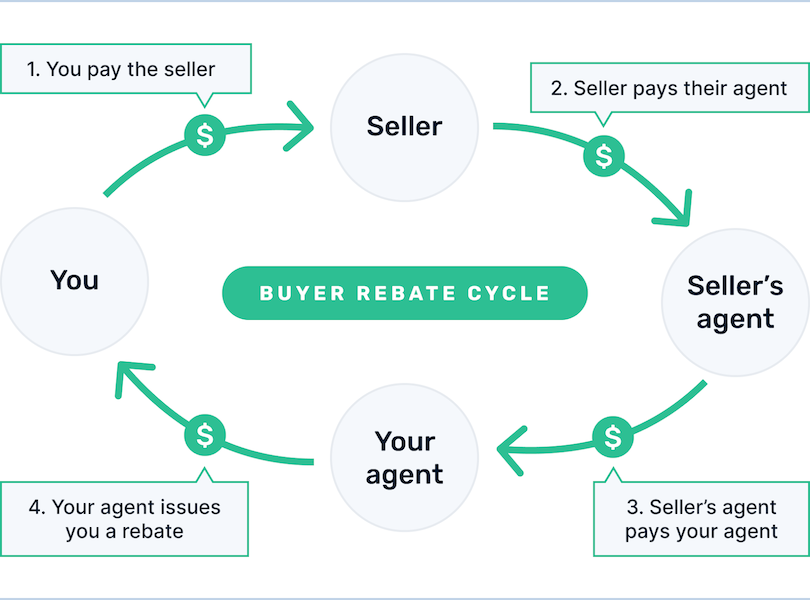
In other words, a rebate isn’t income — money gained via an external source. It’s a portion of your money — which you’ve already earned — coming back to you on the tail end of a transaction.
A rebate could affect your capital gains taxes if and when you resell the property.
The IRS acknowledges that a buyer rebate lowers the home's cost basis. This will likely widen the gap between your original purchase and resale price, which could increase your tax exposure if your future sale is subject to capital gains taxes.
Did your agent issue a 1099-MISC for your rebate?
If the agent or broker who issued your commission rebate has sent you a 1099-MISC form, this is likely a mistake.
Contact the agent or broker and request they issue a corrected form. If they won’t do so, a TurboTax CPA recommends:[4]
- Not including the rebate amount in the 1099-MISC in your tax returns
- Attaching a statement indicating why you didn’t report the rebate (and citing IRS form PLR-157111-06)
- Filing on paper (you can’t e-file if you add a statement to your return)
| ✍️ Editor’s note: Always discuss any legal, tax-related issues with a licensed CPA or tax professional before filing your return. |
How to negotiate a home buyer rebate with your agent
Negotiating a rebate with an agent or broker on your own isn’t easy — but it's possible, depending on the circumstances surrounding your purchase. You’ll have to present them with a compelling reason to hand over a chunk of their commission. Here are some situations where you might be able to convince your agent to give you a home buyer rebate:
You’re buying a high-value home.
If you sell your home at a higher price, your broker or agent likely has more margin with the commission and might be more willing to offer a rebate. Or they might not be—selling expensive homes often requires more work since they take longer to sell. Still, it's worth discussing with your agent if it's something they would consider.
Buyer demand is low in your area.
Whether it’s the off-season or just a cool market, when buyers are scarce, you become a hot commodity! Buyer clients are valuable and agents may be willing to offer "something extra" to secure your business — especially knowing it may be one of their few opportunities until the market returns.
You agree to buy and sell with the same agent.
When you agree to use the same agent or broker to sell and buy, you suddenly become twice as valuable (possibly more) from a revenue perspective. The agent may be willing to offer savings — either in the form of a buyer rebate or reduced listing fee — to secure your business. They're still netting more even if their earnings take a small hit on one of those transactions. Case in point: several discount brokers — Redfin and Houwzer, to name two — offer additional savings to customers who commit to buying and selling with them.
You’re ready to make an offer on a property.
Stumbling upon pre-approved buyers who have already picked out a home is what every agent dreams of: minimal time investment with a high chance of seeing a return. The agent will be very motivated to secure your business.
The agents also know that if they don’t provide exceptional service and support, the company will stop sending new clients their way.
💡 Skip the negotiations and let Clever do it for you. When you work with Clever, you get top performing, pre-vetted agents and can qualify for up to $500 cash back when you buy. No interviews or negotiations required. Get your free Clever agent matches today.
Quick summary and next steps
Home buyer rebates are complicated! Here’s a quick recap of some of the key points from this article:
- Commission rebates are when a buyer’s agent shares a portion of the fee they collect on a purchase with their client.
- Rebates can come in different shapes and forms. They’re most commonly issued as closing credits, but some companies offer cash refunds.
- You must disclose your rebate to your lender and on your HUD-1 settlement form.
- Rebates are not considered taxable income by the IRS.
- Negotiating a buyer rebate yourself is possible — but may be difficult and could create some service-level risks.
- Some agents and services offer built-in rebates, but not all are created equal. It is important to do your homework and understand the respective terms and restrictions.
- Don’t just opt for the agent or service advertising the biggest rebate! Make sure you shop around to find the agent who’s the best fit for your specific needs and goals.