

A comparative market analysis (CMA) is a report a realtor puts together to estimate a home's value. Agents typically prepare CMAs to help sellers set a listing price and buyers decide how much to offer.
To create a CMA, the agent looks at recent sales of similar homes nearby. They take the prices of these homes, then estimate your home's value based on factors like whether your home has more or less bedrooms and bathrooms, square footage, upgrades, or additional features like a garage or pool.
CMAs are more accurate than online estimators like Zillow. Online tools rely on automated algorithms and public data, while CMAs use private MLS data and agent expertise to account for local market trends and specific property details that algorithms may miss.
Ready to sell or buy a home? Get matched with a top local agent who can prepare a free CMA for you.
Our guidance is based on hands-on experience completing comparative market analyses (CMAs) for real sellers and investors.
This article was written by a licensed South Carolina real estate agent who has prepared dozens of CMAs for prospective home sellers. The author is also an active real estate investor and has conducted CMAs to analyze flips and rental properties. These analyses rely on MLS data, recent comparable sales, local market trends, and appraisal benchmarks to determine realistic home values.
The article is also informed by research from Trent Seigfried, a data scientist and real estate writer whose work has appeared in Business Insider, The Christian Science Monitor, and U.S. News & World Report. His research on online home value estimators adds a data-driven perspective to our first-hand market experience.
Overview: What is a CMA?
-
What it is: A report that gives an estimate of a home's value by comparing the recent sale prices of similar properties nearby
-
Who prepares it: Licensed real estate agents
-
Who it's for: Home sellers, buyers, investors, and refinancers
-
Best ways to use it: To set a competitive listing price, determine how much to offer on a home, and get negotiating leverage
-
How accurate it is: Often within ~2–4% of the final sale price, versus estimators like Zillow that can be off by ~7% on average
-
What it costs: Many agents will prepare a CMA for free
Want a free CMA? Get matched with a top local realtor.
Should you get a CMA, an online estimate, or an appraisal?
When to get a comparative market analysis
Get a CMA if you want a detailed, professional estimate of a home’s value. CMAs are helpful:
- When setting a listing price for your home: A CMA helps you price your home competitively — so you don’t leave money on the table or list too high, which could discourage buyers and cause your home to sit on the market for too long. It also helps you understand your potential net proceeds.
- When making an offer on a home: Knowing the market value can help you submit a more competitive offer, avoid offering too much, and stay within your budget.
- When investing in a property: Profiting on a house flip or rental property is all about getting your numbers right. CMAs can help you evaluate undervalued properties, protect you against making a poor investment, and put you in a stronger negotiating position with sellers.
- When applying to refinance a mortgage: A CMA can show whether your home equity meets lender requirements. You typically need at least 20% equity.
When to use an online home value estimator
Use an online home value estimator if you just want a rough idea of a home’s value. They're convenient and usually free. Online estimators are helpful:
- When doing casual research: You can explore potential buying or selling scenarios before getting professional guidance.
When to get an appraisal
Get an appraisal when you need an official, documented home value and you have the money for one. Appraisals are performed by licensed appraisers who inspect the interior and exterior of the home in person, and they cost around $400. Appraisals are helpful:
- When financing or refinancing a home: Lenders typically require a formal appraisal to approve a mortgage.
- When selling for sale by owner (FSBO): An appraisal can help you set a fair and accurate price, even when you're selling without a listing agent. FSBO homes sell for $65,000 less on average than homes sold by an agent, partially because of pricing errors. Getting an appraisal gives you professional guidance to avoid underpricing or overpricing and maximize your profit.
- When valuing a unique property: An appraisal provides a professional opinion for homes that are difficult to compare to others, such as custom-built houses, historic properties, or homes with unusual features. It ensures the value reflects the property’s true market worth and can support negotiations or financing.
How accurate is a CMA report?
A CMA from an experienced agent is one of the most accurate ways to estimate a home’s value. A well-prepared CMA is often within 2–4% of the home’s final sale price. For example, if a home sells for $400,000, the CMA may have estimated a value between $392,000 and $416,000.
CMAs are more accurate than online home value estimators like Zillow and Redfin, which can be off by around 7% on average. For a $400,000 home, the estimate could range from about $372,000 to $428,000. These errors happen because the sites rely on automated algorithms and public data, which may not have the most up-to-date info, account for recent renovations, or use the most relevant comparable sales.
To get the most accurate CMA, work with an experienced local agent. They have more practice analyzing home values, use the most accurate info, choose the best comparable sales, and know how to make pricing adjustments based on your area's market.
CMAs rely on recent sales, so in areas with few transactions — like slow markets or rural neighborhoods — the estimate may be less precise.
Key factors agents weigh in CMAs
Real estate agents consider multiple factors to estimate a home’s value, including:
- Location: The neighborhood, nearby schools, shops, and the street the house is on
- Recent sales dates: Homes that sold recently are the most important for comparison
- Square footage: The total living space and how it compares to other homes
- Condition and upgrades: How well the home is maintained and any improvements like a new kitchen, bathroom, or roof
- Layout and features: Number of bedrooms and bathrooms, garage, yard, and extras like a pool or fireplace
- Lot size: How big the yard is and how easy it is to use
- Market trends: How many homes are for sale, how many buyers are looking, and whether it’s a buyer’s or seller’s market
- Adjustments for differences: Changes in price to account for differences between your home and similar homes
Comparative market analysis example from an agent
This is an example of a real comparative market analysis that I completed for a home in Charleston County, South Carolina. CMA reports may look different in other markets or states, but they all include the same basic information.
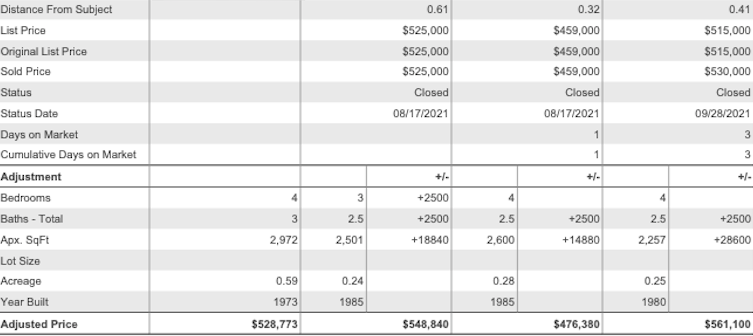
The first two pages of a CMA report include photos and information about the subject property. The third page (image above) provides details on the subject property (second column), along with three comparable sales in the area. Additional pages contain more in-depth information.
How the CMA was prepared
Here’s the process I followed for this example:
- Select comparable homes: I chose three nearby homes that sold in the last four months and were similar in size, condition, and features to the subject property.
- Gather property details: I collected information such as list price, sold price, sale date, distance from the subject property, number of bedrooms and bathrooms, and square footage.
- Adjust for differences: Because every home is unique, I adjusted the prices of the comparable homes. For example:
- The subject home had one extra bedroom, adding $2,500 in value.
- It had a half bathroom more than the comparables, adding another $2,500.
- Additional square footage added between $14,880 and $28,600, based on local market rates.
- Average the adjusted values: After adjustments, the estimated fair market value for this home came out to $528,773.
- Make in-depth adjustments: More detailed CMAs may also adjust for features such as acreage, garage type, or interior and exterior upgrades.
How to do a CMA on your home
Here's how to do a CMA without an agent. This is a basic approach that uses sales data from the home-buying website Zillow.
Step 1: Find homes in your area that have sold recently
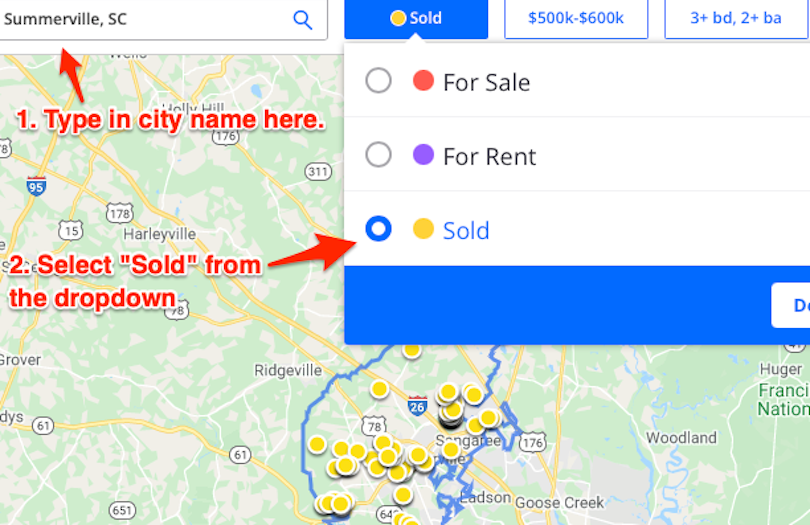
- Type your city in the Zillow search bar.
- Check the box for "sold homes" to view only closed sales.
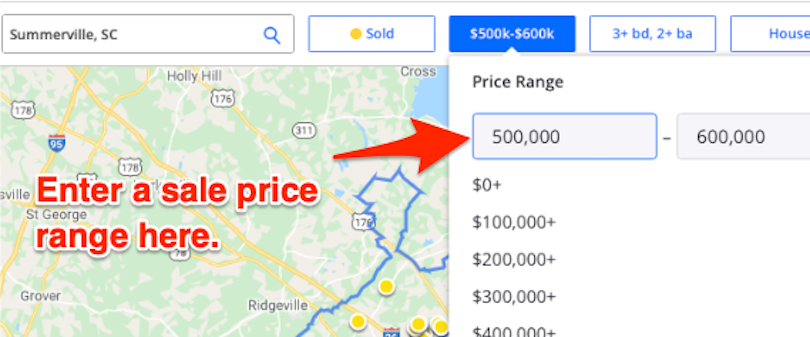
- Choose a sale price range that's within what your home is likely worth.
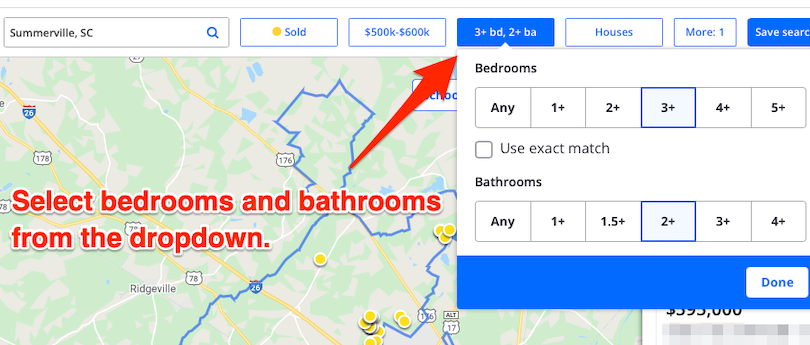
- Select a minimum bedroom and bathroom number that's at least equal to your home.
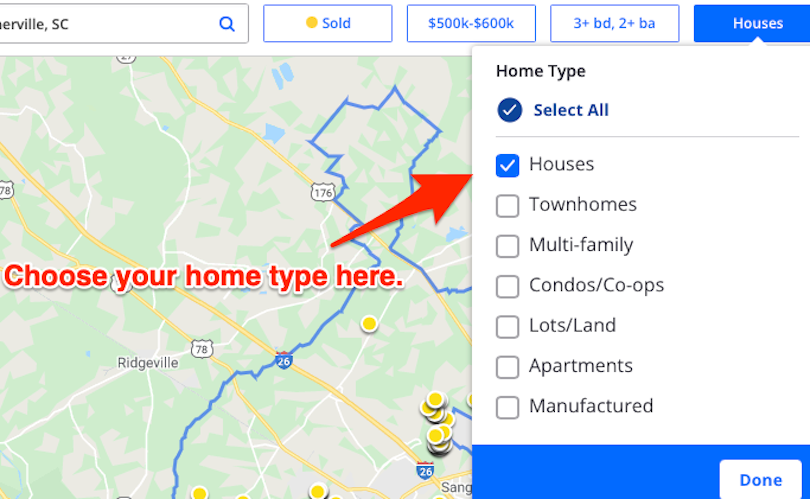
- Choose your home type (single-family house, townhouse/condo, or multi-family).
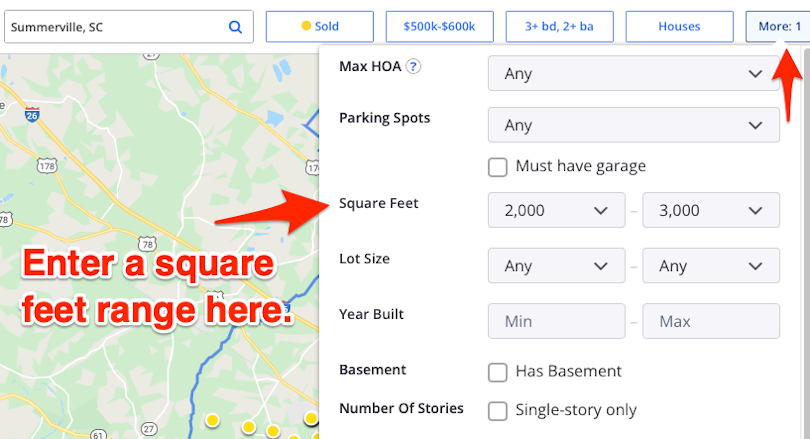
- Add a range of square footage within about 500 square feet of your home.
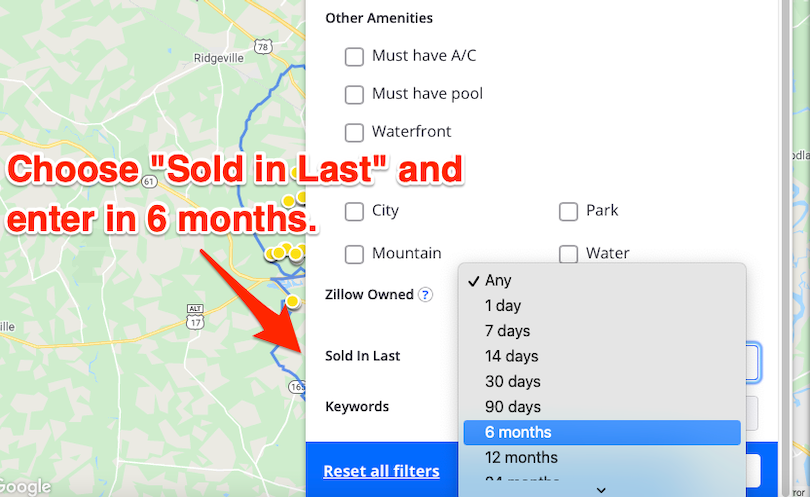
- Under the "sold in last" tab, select homes that have sold within the past six months.
Fill in the information on each Zillow tab, from left to right, to narrow down sold homes in your area.
On the search bar, type in your city, and then on the next tab, check the box for "sold homes" to view only closed sales.
Choose a sale price range that is within what your home is likely worth (using an online home value estimate is okay). For example, if Zillow estimates your home is worth $550,000, you can choose a range of $500,000 to $600,000.
On the next tab to the right, select a minimum bedroom and bathroom amount that's at least equal to your home (don't select "use exact match," which will limit the amount of results).
Choose your home type (single-family house, townhouse/condo, or multi-family) and then hit done.
Select the "more" tab and add a range of square footage that's within 500 square feet or so of your home. For example, if your home has 2,500 square feet, you can choose a range of 2,000 to 3,000.
Scroll down to the bottom, and select the "sold in last" tab. Select homes that have sold within the past six months.
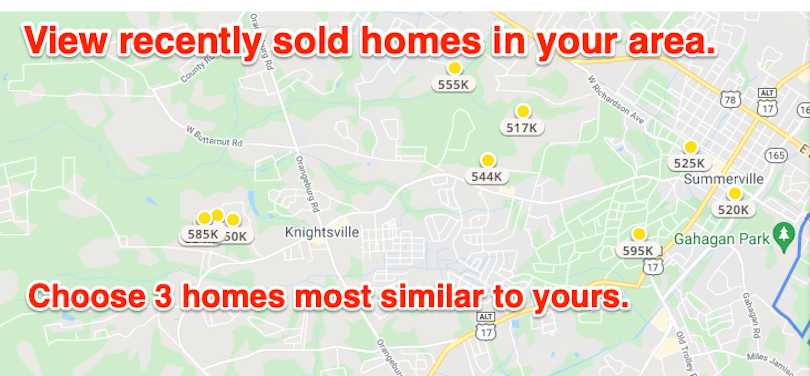
Hit done, and zoom in on the map to view all sold homes in your area.
Step 2: Choose three comparable sales
From this list of homes, pick three that are most similar to your home and have sold most recently.
Use these factors to pick the best comparable sales:
- Location: Comparable properties should be located in the same neighborhood or subdivision as the subject property (and no more than a mile away).
- Date of sale: Homes sold within the past three months are ideal comps, and the sooner the closing, the better, given how fast the market can change.
- Size: Agents typically try to stay within 500 square feet of the subject home's square footage.
- Condition: A home and its comparables should have similar interior and exterior upgrades, and be in the same condition. You can browse online photos to see a home's condition and upgrades.
- Age of home: The closer in age, the better, as the market tends to value new and old homes differently.
- Type of home: A brick, ranch-style home isn't a good comparable for a two-story townhouse or condo, for example.
Step 3: Use averages to estimate your home's value
Two ways you can estimate your home's value are by using the average sale price and the average price per square foot of the comparable properties.
Average sale price
Let's say your search returns three solid comps that recently sold for $517,000, $544,000, and $555,000 in your neighborhood.
Based on the average sale price of the three comps, your home's fair market value is $538,667.
| Property | Sale price |
|---|---|
| Comp 1 | $517,000 |
| Comp 2 | $544,000 |
| Comp 3 | $555,000 |
| Your home's estimated value | $538,667 |
Average price per square foot
To get an estimated value, you'll need to divide each home's sales price by its interior square footage.
The average sales price per square foot for the three comps is $202. If your home is 2,500 square feet, it has an estimated value of $505,000.
| Property | Sale price | Square feet | Price per sq. ft. |
|---|---|---|---|
| Comp 1 | $517,000 | 2,553 | $203 |
| Comp 2 | $544,000 | 2,643 | $206 |
| Comp 3 | $555,000 | 2,800 | $198 |
| Your home's estimated value | $505,000 | 2,500 | $202 |
Your CMA won't be as accurate as an experienced agent's. Agents have access to more data and have more local market knowledge. They know in depth what factors affect a home's value and by how much. If you want to set a competitive listing price, we recommend you get a free CMA from a top local agent.
How to get a free CMA
Most real estate agents will give you a free CMA during a listing consultation to win your business and help you set a fair listing price.
To make sure your CMA is accurate and that you don't overprice or underprice your home, it's important to find the right agent. You want to choose a realtor who's highly qualified and knowledgeable about your local market.
Clever Real Estate can match you with top local agents from trusted brands like Century 21 and RE/MAX. You'll receive multiple hand-picked matches so you can compare your options and choose the agent with the best marketing plan and pricing strategy.
In addition, Clever negotiates exclusive savings on your behalf. You'll pay just a 1.5% listing fee in exchange for guaranteed full service from a traditional agent. Try Clever for free and interview as many agents as you want until you find the right fit — or walk away at any time with no obligation.
Match with top-rated agents from brand-name brokerages, like Keller Williams and RE/MAX, and request a free CMA today! Sellers will save thousands in realtor commissions with pre-negotiated 1.5% listing fees.
Clever's service is 100% free with zero obligation. Interview as many agents as you like until you find the perfect fit — or walk away at any time.
FAQ
Real estate agents often provide free CMAs as part of a listing presentation to prospective home sellers before a house is listed for sale. Get a free CMA from a top local agent.
You can do your own CMA reports by researching comparable home sales on real estate websites, such as Zillow or Realtor. But a local realtor can provide a more in-depth analysis of a home's value, and at no cost to you.
A CMA and an appraisal are not the same thing. Real estate agents complete free CMA reports to provide an estimated home value for clients; licensed appraisers complete appraisal reports for banks or lenders who have ordered the report for home buyers.
The primary purpose of a comparative market analysis (CMA) is to determine a property's value. Most real estate agents will perform a free CMA for sellers, allowing them to set an accurate listing price. A CMA can also help a buyer know whether a home is priced well, allowing them to make a competitive offer.
A CMA typically takes 2–4 hours for an agent to prepare if they don’t need to visit your home in person. The main factor is finding a time to review it with you. So after you request a report, it may take a few days or a week to actually get it.
An agent needs data about homes that recently sold nearby that are similar in size, style, age, and condition to your home. The realtor looks at the prices of these homes, then makes an estimate of your home's value based on factors like whether your home has more or less bedrooms and bathrooms, square footage, upgrades, or additional features like a garage or pool.