
If you’re selling a $500,000 home, the difference between a 1.5% listing fee and a 3% listing fee is $7,500. That’s why Redfin gets so much attention.
The catch is service. Based on our review analysis and HouseCanary sales data, Redfin can be a solid fit when your sale is pretty straightforward. If your sale involves tough pricing calls, negotiation back-and-forth, or inspection headaches, Redfin’s high-volume team model can leave you wanting more hands-on help.
- If your home is easy to sell and you mostly want to keep fees low, Redfin’s 1.5% listing fee (or 1% if you also buy with Redfin) can make sense.[1] That’s roughly half of what most traditional agents charge (2.5–3%), which can add up to thousands in savings.
- If your sale is likely to be trickier — like if you have an old roof, live in a slower market, or think you'll need extra help with negotiations — a traditional local agent often earns their fee by preventing costly mistakes.
- If you want lower fees without a high-volume model, you can also compare other discounted full-service options (including services that match you with local agents at a reduced listing fee). See how much you could save with a full-service agent for 1.5%.
We also looked at market-level performance using HouseCanary data (Aug 2024 to Aug 2025). In that window, Redfin listings sold in a median of 53 days versus 58 days for the broader market and closed at about 99% of list price. These are big-picture averages, so the agent you choose still matters more than the brand. (See “How we analyzed Redfin vs. other listings.”)
Learn more about Redfin fees, service differences, and the situations where Redfin is a smart move, plus when it usually disappoints.
Redfin vs. realtor: Key differences
Redfin's fee and service model looks different, but its performance is similar to that of traditional agents. The main trade‑off is lower listing fees and a higher‑volume, team‑based experience vs. more one‑to‑one support with a traditional realtor.
| Metric | Redfin agents | Realtors | Takeaway |
| Listing fee | 1.5% | ~2.5–3.0% | Cheaper overall; minimum fees raise costs on low-priced homes. |
| Deals closed per agent (annual) | 27 | 10 | Higher agent volume and more team handoffs vs. more one-to-one service. |
| Days on market (median) | 53 | 58 | Slightly faster than the market overall. |
| Sale-to-list ratio | 98.87% | 98.56% | Sale prices are essentially in line with market averages. |
| Median list / sale price | $434,900 / $430,000 | $339,900 / $335,000 | Skews toward higher-priced markets; performance is otherwise similar. |
| Pricing adjustments | Drops 46% · Increases 31% | Drops 43% · Increases 24% | More frequent price changes — a more data-driven, higher-throughput model. |
Tip: Swipe sideways to see all columns.
Source: Clever analysis of Redfin vs. market using HouseCanary data, Aug 2024–Aug 2025.
📊 How we analyzed Redfin vs. other listings
We pulled market-level metrics from HouseCanary Market Pulse Insights, a feature within Acquisition Explorer that aggregates MLS-record data into an interactive dashboard. The dataset used for this analysis was pulled in August 2025 and is available internally in Databricks for reuse in content updates.
Sample definitions
- Redfin listings: We pulled all listings where the listing brokerage name includes “Redfin” (e.g., “Redfin,” “Redfin Corp,” “Redfin Real Estate”).
- Market baseline: All MLS listings in the same geographies and time window, regardless of brokerage.
Geography rules
- Included: Markets covered in HouseCanary Market Pulse Insights during the analysis window.
- Excluded: Markets with incomplete coverage in the dataset or insufficient sample size for stable year-over-year comparisons.
Limitations and context
- MLS-based coverage: Not every home sale appears in the MLS, so the dataset may exclude certain off-market, private, or non-MLS transactions.
- Market mix: Redfin tends to have stronger presence in higher-priced, urban/suburban markets, which can influence averages vs. the overall market.
- Aggregation: Results are market-level aggregates, so they describe broad patterns rather than outcomes for every individual listing or agent.
Redfin vs. realtors: Breaking down the numbers
Here’s what these numbers mean when comparing Redfin agents with traditional realtors.
💰 Lower commission rates. Redfin charges a 1.5% listing fee, significantly lower than the national average real estate commission rate of 2.88%. If you decide to buy your next home with Redfin as well, the listing fee decreases further to just 1%.
🔎 How they're paid. Redfin agents usually earn a salary, while a traditional agent works on a percentage-based commission for each sale.[2] This is pretty rare, as most agents work on a commission basis.
Redfin's top-producing agents under the Redfin Next pay model - in which agents earn competitive commission splits up to 75% - reportedly earned an average of over $300,000.[3]
👥 Team-based vs. agent approach. Redfin agents don’t manage every aspect of your sale themselves. Instead, they work with a team of specialists, including marketers and transaction coordinators. This differs from realtors at other brokerages, who often handle most of the transaction.
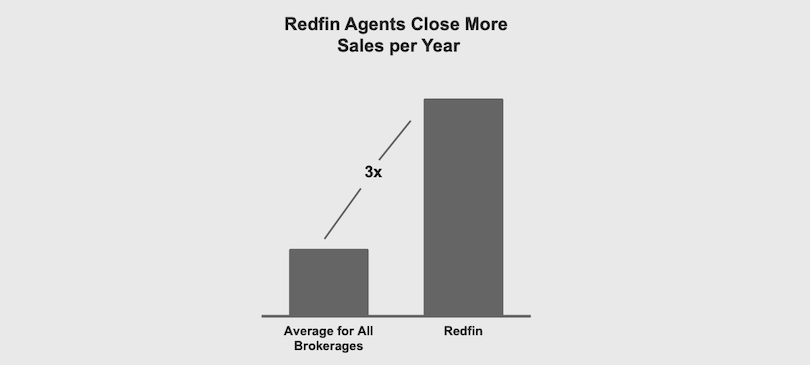
📈 Higher transaction volume. Redfin agents handle three times as many clients as other realtors. Redfin agents close an average of 27 deals annually, compared to just 10 closed by realtors nationwide.[4]
🏠 Similar sale outcomes. Redfin homes sell in about 53 days vs. 58 with traditional agents and close at nearly the same price (98.9% vs. 98.6% of list). Their listings skew higher — a median $435,000 list price vs. $340,000 — mainly because Redfin operates in pricier urban markets.
🔄 More frequent price changes. Redfin agents are more likely to adjust prices mid-sale, with 46% of listings seeing drops and 31% increases (vs. 43% and 24% for traditional agents). This shows a more data-driven, responsive approach, though it can also feel less steady for sellers who prefer consistent pricing guidance.
📉 Why is Redfin bad? Potential drawbacks
Redfin isn't necessarily a "bad" option; rather, it’s just not the right fit for everyone. The company’s lower fees can save you money, but those savings often come with trade-offs.
Because Redfin agents juggle more clients than most traditional realtors, they may have less time for one-on-one support. Some sellers say it was harder to reach their agent or get quick responses during key moments, like negotiations or inspection issues.
By comparison, 83% of recent home sellers report receiving a wide range of services and comprehensive management throughout the sale process from their agents, highlighting the expectation for thorough service.[5]
Other customer feedback notes that some Redfin agents can be harder to reach, less proactive, or less familiar with local market nuances than traditional agents, who typically serve fewer clients and can offer more personalized guidance.
Redfin services: What to expect
Redfin agents offer help with pricing, marketing, showings, offers, paperwork, and closing coordination.
But Redfin agents manage and render these services differently. If you're wondering if and why Redfin is bad, the biggest downside can be the spotty, hands-off service, especially for inexperienced home buyers and sellers.
Consider these differences in how Redfin works for sellers compared to traditional agents.
Redfin fees
When you sell with a Redfin agent, you can expect to save 20–30% in realtor commission fees.
Redfin charges a 1.5% listing fee, lower than the national average of 2.88%. However, this drops to 1% if you buy and sell with Redfin—a potential bargain for those making dual transactions.
| Scenario ($500,000 sale) | Listing fee | What you pay |
|---|---|---|
| Traditional fee | 3% | $15,000 |
| Redfin fee | 1.5% | $7,500 |
| Redfin fee if you buy and sell | 1% | $5,000 |
Note: In some markets, Redfin’s minimum commission can override the percentage for lower-priced homes.
However, Redfin's pricing isn't always as straightforward as it seems. The company has minimum commission requirements in many markets, which can push the cost above 1.5% for modestly priced homes. For example, the minimum commission in San Francisco is $9,000, while in Boston, it’s $6,000 (subject to change by market).[6]
Note on buyer incentives: Redfin and Rocket now offer Rocket Preferred Pricing to qualified borrowers: a one-point rate reduction for the first year or a closing credit up to $6,000. This is a buyer-side incentive (not a change to your listing fee), but it may increase interest from rate-sensitive buyers.
Also, while Redfin’s listing fee is discounted, you may still need to cover the buyer’s agent fee, which averages 2.82% nationwide. Due to recent NAR settlement changes, these fees are now negotiable between buyers and their agents. However, sellers often still agree to cover the fee through seller-paid concessions in many markets (more on this below).
Do I need to pay the buyer's agent?
For years, many sellers offered a buyer’s agent commission because it helped secure more showings and, ideally, more offers. Redfin often recommended doing this to keep your listing competitive.
After the NAR settlement MLS policy changes took effect on August 17, 2024, the big change is where and how buyer-agent compensation is discussed.[7] It’s not a rule that says sellers can’t pay a buyer’s agent (and it still happens frequently).
Here’s what changed:
- Buyer-agent compensation is no longer advertised in the MLS. MLS listings can’t include offers of compensation to buyer brokers, so that info has to be handled outside the MLS.
- Buyers now sign an agreement with their agent before touring homes. That agreement spells out what the agent will do and how they’ll get paid.[8]
- Sellers can still cover the buyer’s agent fee, but it’s negotiated as part of the deal. A buyer might ask the seller to pay it in their offer, or ask for a seller credit to help cover it.[9]
Liz Wood, a New Orleans-based realtor, says this upfront agreement is exactly where the fee conversation now happens.
"Some agents will still take whatever the seller is offering. I don’t," says Wood. "I have my clients sign the agency agreement and tell them ahead of time that if the seller doesn’t offer the full 3%, they have to come up with the rest. That’s my fee if they want to work with me.”
What this means for you as a seller: you’re not automatically “on the hook” for a buyer’s agent fee, but you should expect it to come up in the offer. Some buyer agents will take whatever compensation is available, while others will require the buyer to make up any shortfall. That can affect how many buyers tour your home, how strong their offers are, and how negotiations play out.
Redfin services
Redfin agents offer many of the same general services as traditional real estate agents, including help with pricing, marketing, showings, offers, paperwork, and closing coordination.
However, Redfin agents manage and render these services differently. If you're wondering whether and why Redfin is bad, the biggest downside is its potential for hands-off service, especially for inexperienced home buyers and sellers. This is a key difference from other real estate companies, which offer a more personal, hands-on approach.
1. Higher volume, less personalized attention
Redfin agents close an average of over 27 deals annually, more than three times as many deals as agents at other brokerages named in the top 10.[10]
While this high volume demonstrates their efficiency and success, it could also mean that Redfin agents may have less time to dedicate to each client. They might need to delegate some tasks to team members or take longer to respond to inquiries.
A Reddit user noted that while Redfin’s system is efficient and cost-effective, the experience hinges on the quality of the agent you choose. “If you get a good agent, Redfin can be a great bargain,” they shared. “But if you get a bad agent, no system can fix that.”
Sellers who prefer frequent communication and more personalized attention may find working with a high-volume agent less satisfying.
2. Team-based support model
In a conventional sale, you can go to your real estate agent or one of their direct team members for everything. This approach helps build trust and rapport, with clear accountability.
At Redfin, you’ll work with a larger team of specialists. If you have concerns about how your home is marketed, you must address them with the marketing specialist. Issues with your open house schedule? That might involve another team member.
This team-based model can be more efficient, but it may also feel confusing or frustrating if not managed well.
It’s worth noting that top-producing agents at other brokerages may also work within a team structure. So, it's important to understand how communication will be handled regardless of your brokerage.
3. Tech-driven process
Much of the selling or buying process happens through Redfin’s mobile app and online dashboard.
Redfin’s tech-centric approach may be great for some who prefer communicating and coordinating this way. Still, it could be frustrating or confusing for others — particularly the less tech-savvy among us.
As the Reddit user pointed out, this efficiency doesn’t replace the importance of a good agent who can walk you through complex aspects of the transaction, like understanding commissions or buyer-side fees.
Key tip: Focus on the agent, not just the brand
Not all real estate agents are created equal, which is true for Redfin. While Redfin’s "agent finder" tool offers transparency by providing key details like customer reviews, past deals, and top-performing agents in your market, it's important to look beyond the metrics.
The tool allows you to search for agents by neighborhood or zip code, and even filter by buyer's or seller's agents, as well as Redfin Premier agents specializing in high-end properties.

By selecting an agent's profile, you can see their total closed sales, sales volume, and highest recorded sales price, as well as the number of sales they've completed in your neighborhood.
However, focusing too much on numbers can make it easy to overlook the importance of finding an agent you connect with and who understands your goals. We recommend connecting with agents and setting up interviews to ensure you find someone who aligns with your needs and priorities.
» LEARN: How to choose a realtor to sell your home
Redfin partner agents: What to know
The Redfin Partner Agent program lets outside agents stay with their current brokerage while receiving referrals from Redfin. Agents only pay a referral fee after closing a deal, with no upfront costs.[11] The program connects them with motivated buyers and sellers, offering exposure through Redfin’s marketing.
If you use Redfin's agent finder tool, you may come across Partner Agents. These agents from other brokerages pay Redfin for referrals, typically in markets where Redfin doesn’t have agents or when Redfin agents are unavailable.
Unlike Redfin’s in-house agents, Partner Agents don’t follow Redfin’s pricing model, and buyers aren't eligible for Redfin’s buyer rebate. As a result, these agents may not provide the same pricing benefits or consistency that you’d get from working directly with a Redfin agent or a conventional real estate agent.
Selling with Redfin: Pros and cons
Pros
- Lower fees
- Faster sales
- Team support
Cons
- High minimum fees (in some markets)
- Less personalized service
- Frequent pricing changes
Selling with Redfin has its advantages and drawbacks.
- On the plus side, Redfin offers significantly lower commission, typically around 1.5%, which can save sellers 20–30% compared to traditional real estate transactions.
- Redfin listings sold in a median of 53 days vs. 58 days for traditional agents.
- The company's tech-driven process and team-based support model streamline many aspects of the home-selling experience, making it a good option for those comfortable with technology and looking for efficiency.
However, there are trade-offs to consider.
- Redfin's minimum fees in certain markets can negate some savings, especially for lower-priced homes.
- Its team-based approach may result in less personalized service. Redfin agents close about 27 deals a year vs. 10 for traditional agents, which means they juggle more clients and may have less time for one-on-one attention.
- Redfin agents are more likely to adjust list prices (46% drops, 31% increases), which shows a data-driven approach but can feel less steady for sellers who prefer consistent pricing guidance.
Redfin and realtor alternatives
After comparing Redfin agents vs. realtors, you're likely wondering if there's a middle ground.
Stellar service at a lower commission rate? À la carte options for advanced home sellers? We've got you covered with these Redfin agent alternatives.
1. Get pre-negotiated low rates with traditional realtors
If you’re looking to save on commission but want to avoid customer service trade-offs, consider working with a discount company that negotiates low rates with traditional realtors on your behalf, like Clever Real Estate.
Clever only works with top local brokerage agents like Berkshire Hathaway and RE/MAX. Since Clever connects its partner agents with you at zero up-front cost, it can pass the savings on to you.
This means you'll get the same service and support you'd expect from a traditional realtor, but you'll pay a fraction of the typical price. Fill out this form to get matched with local agents today.
2. Compare Redfin with a discount real estate brokerage
Redfin is just one of the ever-increasing discount brokers out there.
Several national, regional, and local brands are available, each offering a variety of price points, service models, and pros and cons.
Generally speaking, most will come with some sort of variation on the same basic catch:
You can save big on commission fees, but you’ll likely trade-off something (or assume some sort of risk) in return — usually customer service.
We recommend shopping around and comparing Redfin against one to two discount brands — along with one to two traditional agents — to get the best possible value and fit for your needs.
» MORE: The ultimate guide to discount brokers
3. Sell for sale by owner (FSBO)
Selling your home as an FSBO means you're taking on the entire process yourself without the help of a listing agent, which can save you the cost of paying a listing commission, which averages between 2-3% nationwide.
This approach gives you full control over the sale, from setting the price to negotiating with buyers, and using a flat fee MLS service can help make your property visible on the same platforms as agent-listed homes (think: Zillow, Trulia, Realtor.com).
The reality is that very few sellers pull this off successfully. In NAR’s latest Profile of Home Buyers and Sellers, only 5% of homes sold FSBO, the lowest share ever recorded. And FSBO sellers typically net less: FSBO homes sold for a median of $360,000 versus $425,000 for agent-assisted sales.[5]
Selling FSBO isn’t easy — especially if you don’t have real estate experience. It tends to work best for sellers with highly desirable homes in hot markets who have the time, confidence, and know-how to handle pricing, marketing, and negotiations on their own.
But if your goal is to maximize your sale price and have expert support throughout the process, you’re usually better off hiring a professional agent.
⚠️ Warning: Be aware of the FSBO risks!
Selling your home without an agent can be more challenging than it seems. Our survey of home sellers revealed that many FSBO sellers faced significant hurdles, including:
- Overwhelming process. 52% of FSBO sellers felt burdened by managing the entire sale independently.
- Buyer distrust. 43% experienced distrust from buyers because an agent didn’t represent them.
- Home preparation. 32% struggled to get their house ready for potential buyers.
- Offer evaluation. 31% found comparing offers difficult and understanding contingencies.
- Pricing challenges. 30% had trouble setting the right price for their home, likely due to a lack of professional guidance.
Consider partnering with an experienced agent to navigate these challenges and maximize your chances of a successful sale. Clever Real Estate can match you with top local realtors for further assistance.
4. Sell to a 'we buy houses for cash' company
Selling to a cash home buyer can be a quick and convenient option for homeowners looking to offload properties quickly. Recent data shows that 29% of home buyers had all-cash sales (October 2025), virtually unchanged from 30% the month prior, and up from 27% one year ago.[12]
These companies are often willing to purchase homes in any condition, including those in poor shape or vacant lots. Sellers can typically receive a cash offer within days, sometimes even hours, and enjoy flexibility in choosing their move-out and closing dates.
However, the convenience may come with trade-offs:
- Cash offers from these companies are usually well below market value, sometimes by as much as 50%. Our survey of real estate investors who flip houses found that they aim to offer no more than 68% of a home's after-repair value (ARV).
- Additionally, further deductions may be made to cover repair costs after in-person inspections.
- Sellers may also experience persistent follow-up from these companies, even after declining their services.
This option is best suited for sellers who prioritize speed over profit, such as those who need to sell quickly, have inherited an unwanted property, or lack the funds or desire to make repairs.
⚡ Want to sell quickly without the hassle? Clever Offers lets you compare cash offers from trusted buyers near you—without the trade-offs. Get your free, no-obligation offers today!
5. Sell to an iBuyer
Selling to an iBuyer can be a quick and convenient option for homeowners looking to sell their property with minimal hassle.
iBuyers, or instant buyers, are large technology companies that make fast cash offers on homes, often within days or hours of initial contact. Compared to other cash buyers, they typically offer prices closer to fair market value, and some even provide unique options like home trade-ins, giving sellers flexibility.
However, while iBuyers offer speed and convenience, they often have drawbacks.
- Service fees can eat into your profits. These can reduce your profits, making traditional sales potentially more lucrative despite an attractive cash offer.
- Selective criteria. iBuyers often prefer newer homes that are in good condition.
- Limited availability. iBuyers may not operate in all areas, limiting your options.
It might be no surprise then that iBuyers represent a small market segment. According to the National Association of Realtors, less than 1% of all sellers opted to sell through an iBuyer program.[13]
Choosing to sell to an iBuyer might be a good fit if your home meets their criteria, you prioritize a fast and easy sale, and you’re willing to trade some potential profit for the convenience and certainty of a quick cash offer.
But, if maximizing your sale price is your top priority, exploring a conventional sale might be a better route.
FAQ
Is Redfin worth it for sellers in 2026?
Redfin can be a great value for sellers focused on saving money. Its 1.5% listing fee (or 1% when you also buy with Redfin) is well below the national average, and its listings perform about the same as traditional agents on sale price and time to sell. However, Redfin’s team-based, high-volume approach means you may not get as much one-on-one service or local expertise.
Why do some sellers say Redfin is bad?
Redfin isn’t necessarily “bad,” but it’s not the right fit for everyone. Some sellers report slower communication and less personal support because Redfin agents handle three times more clients than typical realtors. A traditional or low-commission full-service agent may be a better match for sellers who value frequent updates and customized guidance.
Are Redfin agents licensed?
Absolutely! Redfin agents are fully licensed agents, realtors, and brokers. Learn more about working with Redfin.
Can you list FSBO on Redfin?
Redfin doesn't allow you to post for sale by owner (FSBO) homes directly on its platform. However, Redfin’s home search portal pulls listings directly from the local MLSs across the country. If you’re listing FSBO and pay a flat fee MLS company to post your listing on your local MLS, it should appear on Redfin.com. Read our complete guide to selling FSBO.
Does Redfin have all MLS listings?
Mostly. Redfin is a brokerage with IDX access in the markets it serves, so most MLS listings appear on Redfin. A small number may be excluded due to syndication settings, office policies, or out-of-area coverage. Find other home buying websites like Redfin.
How do I find a Redfin agent?
Visit Redfin.com, add your city or zip code into the search bar, and then search. Clicking on "Real Estate Agents" in the top-right corner will bring up a list of agents in your area. You can then view individual agents’ customer ratings and deal history.
Does Redfin have hidden fees?
Redfin listing fees are generally pretty transparent, though Redfin does have minimum commissions in some markets. These minimums can sometimes exceed its quoted 1.5% commission rate for homes under a certain price point. See how Redfin compares to other low commission companies.