
When you’re getting ready to sell a house, “just paint it neutral” is one of the most common (and most useless) pieces of advice around. If you’ve been there, then you’re familiar with the resentment of making your house more boring than it currently is, or the pain of standing in the paint sample display, unable to pick one of the forty near-identical whites available for your project. The tension is real, and it isn't about boring versus interesting. It's about non-offensive versus forgettable, and those aren't the same thing.
Warm, light neutrals are the safe floor for the widest pool of buyers, and buyers now pay measurably more for specific deeper colors in specific rooms. A chocolate brown bedroom, for example, drew offers about $2,277 higher than a white one in Zillow's 2026 survey of more than 4,400 recent and prospective buyers.[1]
So the real question isn't "what's a safe color?" It's "where do I play it safe, and where can I maybe make a little more money?" That's a decision, not a color theory lesson, and it's the one you're about to make.
Should you paint your house before selling?
Painting before you list is usually worth it. It's one of the lowest-cost, highest-visibility changes you can make, and it signals a home that's been cared for. But there are reasons to skip painting, too; it really depends on your house, the other homes for sale in the area, and buyer expectations.
There are four situations where spending money on painting is the wrong move.
- If your walls are already a clean, warm, light neutral in good shape, a fresh coat of the same family buys you almost nothing; clean them and consider selling as-is instead.
- If you're selling to an investor or for land value, the buyer is pricing the lot and the layout, not your wall color, and companies that buy houses for cash rarely factor paint at all.
- If your market is hot enough that comparable homes are going under contract in days with multiple offers, cosmetic prep matters less.
- If your timeline is too tight to test samples and let a crew do it right, a rushed paint job photographs worse than clean existing paint; when you need to sell fast, that time pressure is a real reason to skip it.
Real estate pros tend to land in the same place here, which is worth noting because they don't always agree on much else. Daniel Amodeo, president of Amo Realty, a brokerage operating since 2007, puts the ceiling on expectations: "I think paint color absolutely influences buyer perception, but I don't think there is any magic color that adds property value. … I also tell sellers not to repaint just because a trend changed. If the current paint looks good, I'd rather they spend their money on professional cleaning, decluttering & improving curb appeal than repainting a room that's already perfectly acceptable."
Clint VanRossun, owner of VanRossun Contracting in Austin, draws the same line from the job site. He tells clients to skip the repaint when the existing color is truly neutral and in good condition, because "if you have that budget tied up in paint, it's likely better spent on updating worn elements. Fresh paint isn't going to sell a kitchen with dated hardware and tired cabinet finishes."
Then there's the other pole. Victoria Massengale, an estate director at Compass in Los Angeles who has spent more than 20 years with architecturally significant homes, tells sellers to paint almost every time. She recently listed a home that hadn't changed hands in 47 years, where the owners assumed a developer would level it and painting was pointless; she talked them into paint and staging, and they wound up with 22 offers. For her, "painting is never a waste of money." Just keep in mind that's the luxury and design-forward end of the market, where buyers expect a finished product. Weigh it against your own price point before you commit the budget.
If you've been thinking "let the buyer decide" or "location and price matter more," you're not wrong, exactly. Location and price do matter more. But a buyer who can see through your paint is rarer than you'd think, and most of them are reacting to the first photo online before they've reasoned about anything.
Why neutral paint colors help homes sell faster
There's a reason "paint it neutral" became the default advice: It works. Warm, light colors reflect more light, which makes a room read as more open and clean in person and in photos. That's the whole trick. No specific square-footage claim survives scrutiny, so ignore anyone who promises you a percentage; what you're buying is a brighter, calmer first impression.
The deeper reason is what sellers themselves call the "blank slate" effect. A warm, light wall reads as a blank canvas, which lets a buyer mentally move their own furniture in instead of doing the math on what it would cost to undo yours. Neutral colors also don't clash with anyone's taste, so nobody gets turned off the moment they walk in. And fresh, even paint quietly signals "well cared for," which is the impression that makes a home feel move-in ready before a buyer can explain why.
An important caveat is that warm and light is the floor, not the ceiling. It's the safe baseline. The next question is where you can beat the baseline.
What paint colors sell a house for the most money?
Research sometimes directly contradicts the "just paint it neutral" advice. Zillow's 2026 analysis surveyed more than 4,400 recent and prospective buyers and put dollar figures on how specific colors move offers, room by room.[2] One thing to understand about what the numbers mean: These are differences in what buyers offer compared with a white room, not changes to your appraised value. Paint doesn't move an appraisal. It moves demand, and demand is what shows up in the offers.
Massengale frames that distinction more precisely than the study does. As she puts it, "It isn't so much that people will pay more for homes that are warmer, but they are going to attract more buyers, which will likely bring a higher sales price. So, I wouldn't say you can list it higher, but you can certainly net more. The trend at the moment is moody, darker photography, accessories that feel found; buyers are so tired of the same white walls, white sofas, and white boxes. Warm neutrals are still good, but a moody bedroom or powder room really hits." That's the mechanism behind every figure below: You're not setting a higher price, you're widening the pool, which then competes more aggressively for the price you set.
What buyers pay more for, room by room
| Bedroom | Chocolate brown | +$2,277 | Turkish Coffee SW 6076 |
| Living room | Pale blue | +$1,723 | Tradewind SW 6218 |
| Living room | Charcoal gray | +$1,509 | Peppercorn SW 7674 |
| Kitchen | Charcoal gray | +$1,373 | Peppercorn SW 7674 |
| Bedroom | Charcoal gray | +$1,240 | Not named |
| Bedroom | Sage green | +$1,035 | Liveable Green SW 6176 |
| Kitchen | Dark plum | +$867 | Expressive Plum SW 6271 |
| Bedroom | Pale blue | +$839 | Tradewind SW 6218 |
| Living room | Sage green | ≈ +$500 | Liveable Green SW 6176 |
| Source: Zillow[1] | |||
Zillow's own bottom line is that repainting the top-performing color in each room could add more than $5,000 to a seller's total.[1]
If you can only repaint one room, make it the kitchen. It's the highest-stakes room in the data: the spread from the best kitchen color to the worst runs about $8,000, from charcoal gray at +$1,373 all the way down to ochre yellow at −$6,630.[1]
Now for the complication, because taking Zillow's numbers at face value would be a mistake. Derek Shewmon, co-founder of HOMEstretch, sees the opposite pattern across the thousands of homes his company preps for sale nationally. As Shewmon explains, "Despite Zillow's research highlighting darker, earth-toned colors, we have seen the opposite across the thousands of homes we help prepare for sale across the country. Painting the interior of a home in a bold color can significantly reduce a home's final offer, as buyers immediately factor in the time, effort and expense required to repaint the entire home upon move-in. Our team has continued to find that trusted warm neutral schemes sell their homes faster and for more." Both of those can be true, and the thing that reconciles them is saturation, not the color name. VanRossun works it out from listings in his own market. He's found the Zillow pattern holds in Austin, where "chocolate and mocha bedroom walls photograph with richness and warmth that just cannot be captured with neutral beige. The difference between a color that adds interest versus one that subtracts from it comes down to saturation. A deep, intentional tone will read as curated. Too bright or saturated of the same color will feel like a risky gamble."
That's a decision rule you can use instead of a color list. A deep, muted, intentional tone in one well-lit room can pay; a bright or busy one anywhere reads as a repaint bill.
Sage green is the safest color to take a risk on
If you want something other than white but you don't want to gamble, sage green is the lowest-variance bet in the whole study. It was the only color to land in the top tier of every room tested.[2] The upside is modest but consistent, around +$1,035 in a bedroom and roughly +$500 in a living room.[1] Liveable Green SW 6176 is the shade Zillow names for it. Think of it as the compromise color for the seller who's tired of white but doesn't want to explain a bold choice to every buyer who walks in.
Best interior paint colors for selling a house
The durable answer to "what should I paint inside" is warm and light, and undertone matters more than whether you call the color gray or white. That single reframe is what separates a home that reads fresh from one that reads dated, and it holds up across rooms, markets, and years better than any specific trend.
Best overall interior colors
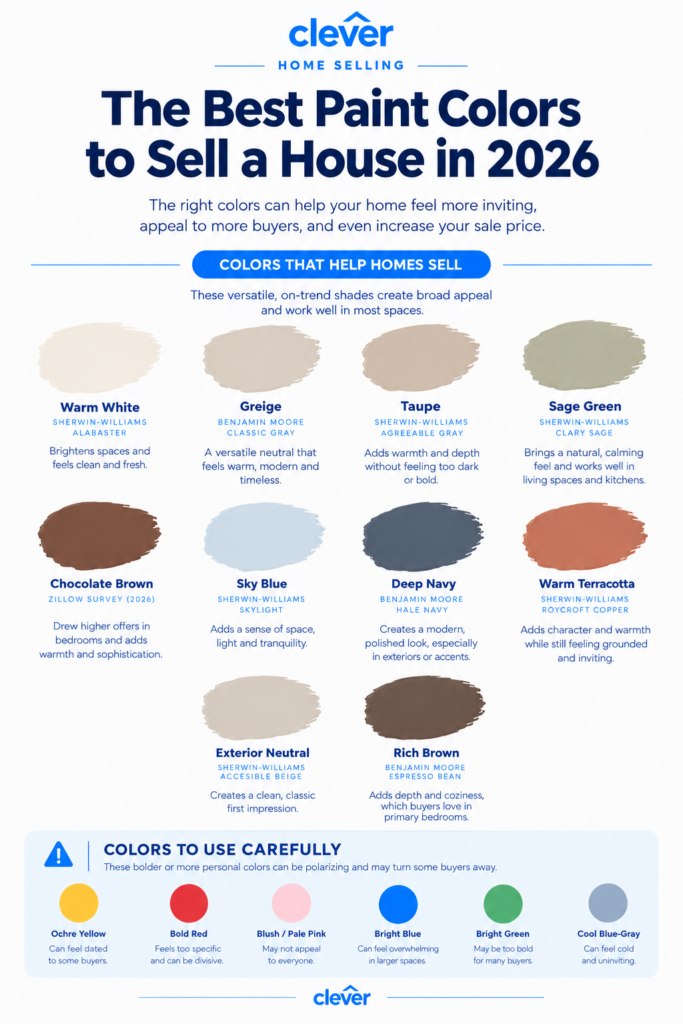
Warm whites are the top choice for resale. They brighten rooms and work well with warm wood tones or limited natural light. Reliable options include Sherwin-Williams Alabaster (SW 7008), a soft and inviting white rather than a stark one; Benjamin Moore White Dove (OC-17), which plays with both warm and cool finishes; and Behr Swiss Coffee (12), a forgiving white that hides minor wall flaws. Sellers and painters also reach for SW Snowbound, SW Dover White, SW Shoji White, SW Creamy, and SW Extra White, plus BM Cloud White and BM Chantilly Lace for trim and ceilings.
Soft greige, a mix of gray and beige, is the next tier, with one condition attached: Check the undertone before you commit. Sherwin-Williams Agreeable Gray (SW 7029) balances warm and cool, and Benjamin Moore Revere Pewter (HC-172) suits open floor plans. The greige that works is warm; the greige that dates is cool, which is exactly the distinction the next section is about.
Light beige and taupe round out the safe list, especially for traditional homes, adding warmth while staying neutral. Glidden Pebble Grey stays subtle without reading yellow, and Behr Sandstone Cove (730C-2) is a classic for traditional exteriors and interiors alike.
Is gray over?
If you already have gray walls, you've probably heard the backlash. Sellers and painters online are calling gray "flipper gray," "cookie cutter," and "dirty," and steering hard toward warm white. It's tempting to conclude gray is finished. But Zillow's 2026 data still shows charcoal gray as a positive: about +$1,509 in living rooms and +$1,373 in kitchens.[1] So which is it?
The fix is undertone and application, not abandoning gray. Joy Aumann, a licensed realtor and interior designer with two decades of luxury staging experience, draws the line better than anyone. As Aumann explains, "A soft, warm grey can look wonderful if the cabinets and flooring are equally soft, warm and grey. Cool blue-gray walls don't work well with warm color tile, wood, or cream counters. Taupe or a soft off-white go much better. Flipper gray isn't a shade, it's just applying the same cold shade to all of the walls, anywhere and in any house." The problem was never gray. It was one cold gray slapped on every surface regardless of what the room already contained.
VanRossun gets to the same conclusion from a different direction: If your gray is the cool blue-gray that took over during the quick-flip era, repaint it; gray with green or brown undertones still plays well. And he adds a test you can run yourself: "the cool shades read dated IRL wayyy before they do in photos." Go stand in the room. Don't judge it from a listing photo, and don't judge it from a two-inch swatch.
Massengale takes the hard line: "I would tell Sellers to paint the gray immediately. Gray flooring and counters are going to diminish your returns too. If Sellers are able, I suggest they replace anything gray. Walls are an absolute must to paint, counters and floors are best changed too." That's the luxury and estates view, where buyers expect nothing to remind them of a flip. Two pros telling you "it depends on the undertone" and one telling you "repaint it now" is more useful than a fake consensus because it tells you exactly where your own home sits on that spectrum.
Gray became the safe default, then aged the way beige did before it. The lesson isn't gray versus white. It's that warm and light outlasts whatever's currently trendy, which is the one bet that doesn't expire.
Undertones, your floors, and your light
Two mistakes trip up more sellers than any color choice, and both are fixable once you understand what to evaluate.
The first is fighting your own fixed materials. Honey-toned floors don't sit well under a white or cool gray wall, and no amount of shade-shopping fixes that; the floor wins every time. Match your wall color to what you can't (or don’t want to) change: the floors, the tile, the counters, the stone. Those set the temperature of the room, and your paint has to agree with them.
The second is trusting a two-inch sample card. A swatch card lies. One seller's warm white read as mustard under a yellow-lit basement fixture, and a small card held near a window would never have caught it. Aumann's advice is the fix, and it's the single most useful step in this whole guide: "Make sure not to choose from tiny color sample before testing the color on several walls for 24 hours to see how it looks throughout the day."
Emily Kantz, Sherwin-Williams' color marketing manager, gives the same guidance through HGTV, recommending you audition shades on poster boards and look at them at different points across the day, because a color shifts dramatically with natural light, artificial light, and the surrounding finishes in a room.[3]
So the practical version is short: Sample big, sample on more than one wall, and look at it in the morning, in the afternoon, and under the lights you turn on at night.
Room-by-room guidance
Consistency matters more than creativity, but a few rooms have space to reward a smart choice.
Living rooms and hallways are high-traffic connectors, so they need to flow. Run one consistent warm neutral through them: Agreeable Gray, White Dove, or Alabaster all hold up. This is where a single throughline keeps a home from feeling chopped up.
Bedrooms are where the data gives you permission to reach a little. A light greige or warm beige is the widest-appeal choice, but a chocolate brown bedroom was the top performer in Zillow's study, so a deeper, grounded tone is the highest-upside gamble if, and only if, the room has good natural light and enough size to carry it. Aumann's guardrail is the one to remember: dark colors work "in rooms with lots of natural light, gorgeous finishes and a large enough space that the dark doesn't dominate the room and turn it into a cave."
Kitchens do best with warm white walls, like Alabaster or Swiss Coffee, so the cabinets, counters, and backsplash carry the room. Charcoal gray is the strongest option the data supports here, under the same size-and-light condition. Let the fixed elements lead either way.
Bathrooms want soft white or light greige, which reinforce a clean, move-in-ready impression without much risk.
Interior paint colors that can cost you
The downside is steeper than the upside, which is a better reason to choose carefully. The colors that lose money lose a lot more than the winners gain.
Ochre yellow is the worst offender in the study. Used through the kitchen, living room, bedroom, and bathroom, it's associated with roughly $18,164 off the offer price, with about $6,630 of that in the kitchen alone.[1] Bathrooms carry the single largest per-room penalty: a bold red bathroom drew offers about $7,971 lower than a white one, and a blush pink bathroom about $6,013 lower.[2] Pale pink lands in the bottom three for every room, costing an estimated $6,013 in a bathroom and $4,201 in a kitchen.[1]
Beyond the specific shades, a few patterns cost money the data doesn't itemize. Bold accent walls read as a project a buyer has to undo. Highly personalized or themed palettes narrow your audience to people who happen to share your taste. And a different color in every room breaks the visual flow, which makes a whole house feel smaller and less cohesive.
Shewmon sees the same failures on the cool end of the spectrum, not just the loud one. He steers sellers away from cool blue-gray, "as it tends to appear flat and cold under overcast lighting and doesn't elevate listing photos," and points instead to modern warm grays like Worldly Gray SW 7043 or Anew Gray SW 7030, which carry subtle beige undertones that read fresher and more move-in ready. (Worth noting: HOMEstretch holds a national Sherwin-Williams partnership, so the shades Shewmon names are all SW. The principle behind them, warm undertones over cool, holds regardless of brand.)
The right finish for listing photos
Color gets the attention, but finish, or sheen, quietly decides how a wall reads in a photo. It's worth getting right because it's cheap to get right.
For most walls, eggshell is the safest choice. It reflects light softly, hides minor imperfections, and photographs cleanly without glare. The reason comes down to how sheen handles light: a wall with too much shine throws the camera's flash straight back and loses the detail that makes a room read as clean, while a wall with no sheen at all scuffs easily and shows every mark during showings. Eggshell sits in the middle, which is why it wins for resale. Flat can work in low-traffic rooms, but it marks up fast.
Save semi-gloss for trim, doors, and baseboards. It's more durable, wipes clean, and adds a subtle contrast that frames a room without shouting. Durability earns its keep in kitchens, hallways, and bathrooms, where fingerprints and moisture live. Just keep the sheens uniform: one finish on the walls, one on the trim. Mixing too many reads as busy in listing photos, the same way mixing too many colors does.
Best exterior paint colors for selling a house
Curb appeal is the first photo and the first impression, so exterior color is doing real work before a buyer reaches the door, and it feeds directly into your overall curb appeal. The safe exterior colors are the same family as the safe interior ones: white and off-white, light gray or greige, and soft beige. They photograph well and read as well-maintained.
Reliable choices include Sherwin-Williams Alabaster and Benjamin Moore Simply White (OC-117) for white and off-white; Sherwin-Williams Repose Gray (SW 7015) and Behr Silver Drop (790C-2) for light gray or greige; and Benjamin Moore Edgecomb Gray (HC-173) for a soft beige.
Let your roof and fixed materials guide the pick: warm-toned roofs pair with beige or warm greige, cooler roofs with light gray or crisp white. Stone, brick, and hardscape can't be changed easily, so the body color has to complement them. Deeper shades belong on accents only, like a front door or shutters, where they add contrast without taking over the house.
How to stand out without scaring off buyers
If you've been told "white or gray" while your whole block is already white or gray, the advice feels like a dead end. But the goal was never boring; it's non-offensive, and non-offensive doesn't have to mean forgettable. You can be memorable without being a gamble, and the trick is where you put the personality.
Keep the body neutral, then let the front door and accents carry the interest, and match the neighborhood and your fixed materials while you do it. Shewmon makes the case for concentrating your one bold move at the entry: the front door is "a primary focal point of exterior photos, which can capture a potential buyer's attention whether they're scrolling online or walking the neighborhood."
He points to a rich, darker neutral like Iron Ore SW 7069, which creates strong contrast against lighter siding without over-customizing the house. The same logic extends inside for a small accent or two, like a staircase handrail in Peppercorn SW 7674, if you want one deliberate note of depth.
Here's the detail almost no one mentions: buyers stand at your front door while the agent works the lockbox. That entry gets the longest sustained look of any surface on the house, inside or out. It's worth prepping properly, not just painting, because it's the one spot a buyer studies at arm's length.
Exterior paint colors that hurt resale value
Some exterior colors make a buyer hesitate before they've even parked.
- Highly saturated body colors, like bright blue, green, or red, feel too bold for most buyers and read as a future repainting cost.
- Ultra-dark siding in a hot climate can raise real concerns about heat and energy bills, so it works against you where summers are long.
- Clashing trim and accents create visual noise; balanced, simple combinations read far better.
- Overly trendy choices age badly by definition; the same gray-then-beige cycle that plays out inside plays out on the siding, so a timeless neutral outlasts whatever the current fashion is.
How much does painting before selling cost?
What you'll spend depends on what you're painting, interior, exterior, or both, and the ranges are wide because home sizes are. According to Angi's 2026 data, interior painting runs an average of about $2,022, with a total range from $350 to $5,800, or roughly $2 to $6 per square foot of paintable surface.[4] Walls alone land around $2.75 per square foot, and including trim and ceilings pushes it closer to $4.70. Exterior painting is higher: a typical $1,819 to $4,551, averaging about $3,178, or $1.50 to $4 per square foot, with a full range of $600 to $7,700.[5] One thing to watch: those per-square-foot figures are for paintable surface, not your home's floor area, so don't multiply them by your square footage or you'll badly overestimate. Paint is one line on a longer list of upgrades; see the full cost to sell a house for how it fits.
DIY can look like the way to save, but for a home you're selling, speed and finish quality usually matter more than the labor savings. Uneven coverage and visible brush marks show up in photos and during showings, and they undercut the good first impression that you painted to achieve. A professional crew is often the better call, though not always; if your existing paint is already neutral and in good shape, the smartest move might be no paint job at all.
Is painting worth the return on investment?
Fresh paint is one of the lowest-risk, highest-impact changes you can make before listing. It improves your listing photos, the feel of a showing, and how confident a buyer feels about making an offer, and homes that read clean and move-in ready tend to draw stronger interest early. Painting rarely hurts, and it usually helps.
About 32% of all sellers painted their home's interior as part of selling, and among sellers who made any improvement at all, interior paint was the single most common project, at 46%.[6] Exterior paint runs lower, at 19% of all sellers and 28% of those who improved anything.[6]
On the return side, Angi estimates interior painting recoups close to 107% of its cost, though as an aggregator that's an illustrative benchmark rather than an appraisal.[7] On a $2,022 interior job, that's roughly $2,160 back in stronger offers, give or take your market.
Here's the objection worth answering directly: Buyers often repaint after they move in anyway, so why pay for it? Because the repaint they do later is about making the house theirs, not fixing what you left. Your paint's job is to get them to say yes in the first place, and a home that photographs well and feels finished gets more of them competing. That's an argument against over-investing, not against painting.
If your budget is real but limited, weight it toward the inside. As Marilyn Comiskey of The Comiskey Group frames it, "If you have only $5,000 for painting, use it all, but keep it simple … put $3,000 toward interior painting, which will have the greatest impact on most buyers." The interior is where a buyer spends the showing, so that's where the dollars work hardest.
Your pre-listing paint checklist
Run through this before the crew shows up and before the photographer does:
- Buy full-size samples, not cards.
- Paint each sample on at least two walls in every room you're testing.
- Look at every sample in the morning, in the afternoon, and under your evening lights.
- Hold the sample against your floors and counters, not just the wall.
- Pick one neutral to run through the main living areas for flow.
- Save the deeper color for one contained room with good light, if you use one at all.
- Match your exterior body color to your roof, brick, and stone.
- Put the personality in the front door.
- Keep sheens uniform: one finish on the walls, another on the trim.
- Shoot your listing photos after the paint has fully cured, not the same day.
How a real estate agent helps you choose the right colors
At some point the smartest move is to ask someone who watches your specific market, and that's usually the advice sellers land on themselves: Your agent knows what buyers in your area are responding to right now. A good agent sees which listings draw fast, strong offers and which ones sit, and they can tell you when a simple repaint will pay and when spending more won't move the needle.
That local read matters more than it might seem because the offer-impact figures above are national averages. A charcoal kitchen that earns a premium in one metro can fall flat in another, and an agent who's watched fifty nearby listings close knows which way your market leans. Instead of guessing from a national study, you get guidance tied to real buyer behavior on your street.
🏠 Ready to sell? Get matched with a top local agent through Clever and save on commission while getting a straight answer on exactly which updates will pay off in your market.
Author calculations
The roughly $8,000 kitchen spread is charcoal gray (+$1,373) minus ochre yellow (−$6,630), or $8,003, matching Zillow's "nearly $8,000." The roughly $2,160 return applies Angi's 107% interior-painting ROI to Angi's $2,022 average interior job ($2,163.54).
FAQ
Should I paint the ceilings and trim too, or just the walls?
Walls first; that's where your money works hardest. Ceilings only need attention if they're stained, yellowed, or you've just pulled down popcorn texture. Trim is worth doing when it's scuffed or a dated off-white sitting next to fresh walls because the contrast makes old trim look worse than it did before. Adding trim and ceilings moves the cost from roughly $2.75 to $4.70 per square foot.
How soon before listing should I paint?
Paint before your listing photos, not after. Photos get shot once and follow the listing everywhere, so repainting later means either reshooting or living with images that undersell the house. Give yourself two to three weeks: about a week to test samples on real walls, and another for a professional crew. Painting after a listing has gone stale rarely resets buyer interest.
Can I just refresh my walls in the same color instead of picking a new one?
Yes, and sometimes that's the smarter spend. If your current color is a warm, light neutral in decent shape, a same-color refresh cleans up scuffs without paying for primer, extra coats, or a color you'd need to test first. You'll also avoid touch-up mismatches down the line. Switch colors only when the existing shade is dark, cool-toned, or clearly dated.
What if I already painted a bold color I love?
You don't have to strip the whole house. Look at where the color lives. A saturated dining room or powder room reads as a deliberate design choice; the same shade across every wall reads as a repaint bill. Keep the bold in one contained space, bring the main living areas back to a warm neutral, and check how it photographs before you commit.
Does fresh paint actually raise my appraised value?
Not directly. Appraisers work from square footage, condition, and comparable sales, and a coat of paint rarely moves that number on its own. What paint changes is demand: a home that photographs well and feels move-in ready draws more showings and more competing offers. The lift shows up in what buyers offer, not in the appraisal.