

When buying a house, you’ll likely encounter words and phrases that could be deal-breakers, and “asbestos siding” is one of them. Should you consider buying a house with asbestos siding? Typically, the answer is yes — if the siding is intact and you budget for management.
Federal guidance from the Environmental Protection Agency and Consumer Product Safety Commission is clear: If asbestos-containing materials are in good condition, the safest option is usually to leave them alone.[1][2] Health concerns arise when siding gets damaged during renovation, removal, or when it dries out and cracks with age, which is when asbestos fibers can be released into the air and inhaled.
If you’re considering a home with asbestos siding, here’s what to do:
- Confirm condition: Get a professional inspection and asbestos testing.
- Decide on your plan: Leave it, encapsulate it with sealant, cover it with new siding, or remove it (last resort).
- Use findings to negotiate: Inspection results give you leverage on price or seller concessions.
💡 Key takeaways
- Asbestos cement was a popular siding on homes built during the mid-1900s.[3]
- When left alone and intact, asbestos siding poses no threat to human health.
- Aging asbestos siding will eventually need to be repaired, covered, or replaced — costing anywhere from a few hundred to several thousand dollars.
- While sellers are required to disclose known asbestos to a prospective buyer, they aren’t legally obligated to fix it. If you want it removed prior to move-in, you’ll need to address the issue during negotiations.
- As a buyer, you could get a good price. Some sellers assume buyers won’t want to pay full price for a home with asbestos and adjust their asking price accordingly.
- Most lenders will finance homes with asbestos siding, but the deal can hinge on condition and appraisal or repair requirements.
- Your strongest leverage is the inspection contingency and contractor quote.
Talk to a local real estate agent who has handled older homes before. They'll know which inspectors to call and how to structure offers that account for asbestos management costs.
Quick decision guide
Use this checklist to assess risk level. The condition of the siding matters more than its age.
🟢 Green flags (low concern)
- Shingles are intact with no visible damage
- Surface is painted or sealed
- No crumbling, chalky residue or stucco-like dust
- No plans to drill, cut, or renovate the siding
🟡 Yellow flags (proceed with caution)
- Minor cracks near windows, doors, or corners
- A few missing or loose shingles
- Murky maintenance history
🔴 Red flags (requires immediate action)
- Widespread breakage or deterioration
- Renovation or siding work planned within 1-2 years
- Friable (crumbly) stucco-like material
- Visible dust or powdery debris around siding edges
If you're buying, a local agent can help you price this risk and negotiate concessions, whether that's a credit for encapsulation, coverage installation, or a price reduction.
What is asbestos siding?
Asbestos siding is an exterior cladding commonly found on U.S. homes built from the early 1900s through the 1980s. It’s made by mixing asbestos (a naturally occurring mineral fiber) with cement.
For buyers, the most important thing to know is how asbestos is bound in the material. In siding, asbestos fibers are typically cement-bonded, which means they’re hard, dense, and usually non-friable (not easily crumbled). That’s why asbestos siding is generally considered low-risk as long as it remains intact.
This cement-bonded structure is also why asbestos siding became so popular. It’s extremely durable; resistant to fire, pests, and weather damage; and it can last for decades without significant deterioration. Many homes still have original asbestos siding that performs well today.
However, once it starts to crack, chip, or crumble, those bound fibers can become airborne. That's why condition assessment is critical. If the siding is solid and undisturbed, it's generally safe to leave in place.
Pros and cons of asbestos siding
Before deciding whether a home with asbestos siding makes sense for you, weigh the pros and cons. The siding itself is often less risky than interior friable asbestos materials. Risk spikes when the material is disturbed by cutting, drilling, sanding, or removal.
| 👍 Pros | 👎 Cons |
|---|---|
|
|
What does asbestos siding look like?
Asbestos siding comes in many styles, which is why it’s often hard to identify at a glance. Common forms include:
- Corrugated sheets that resemble metal siding
- Flat or shingle-style boards, often called “transite” siding
- Cement-based products designed to mimic wood grain, brick, slate, or stone
Some older homes also used asbestos-containing stucco or textured exterior coatings.
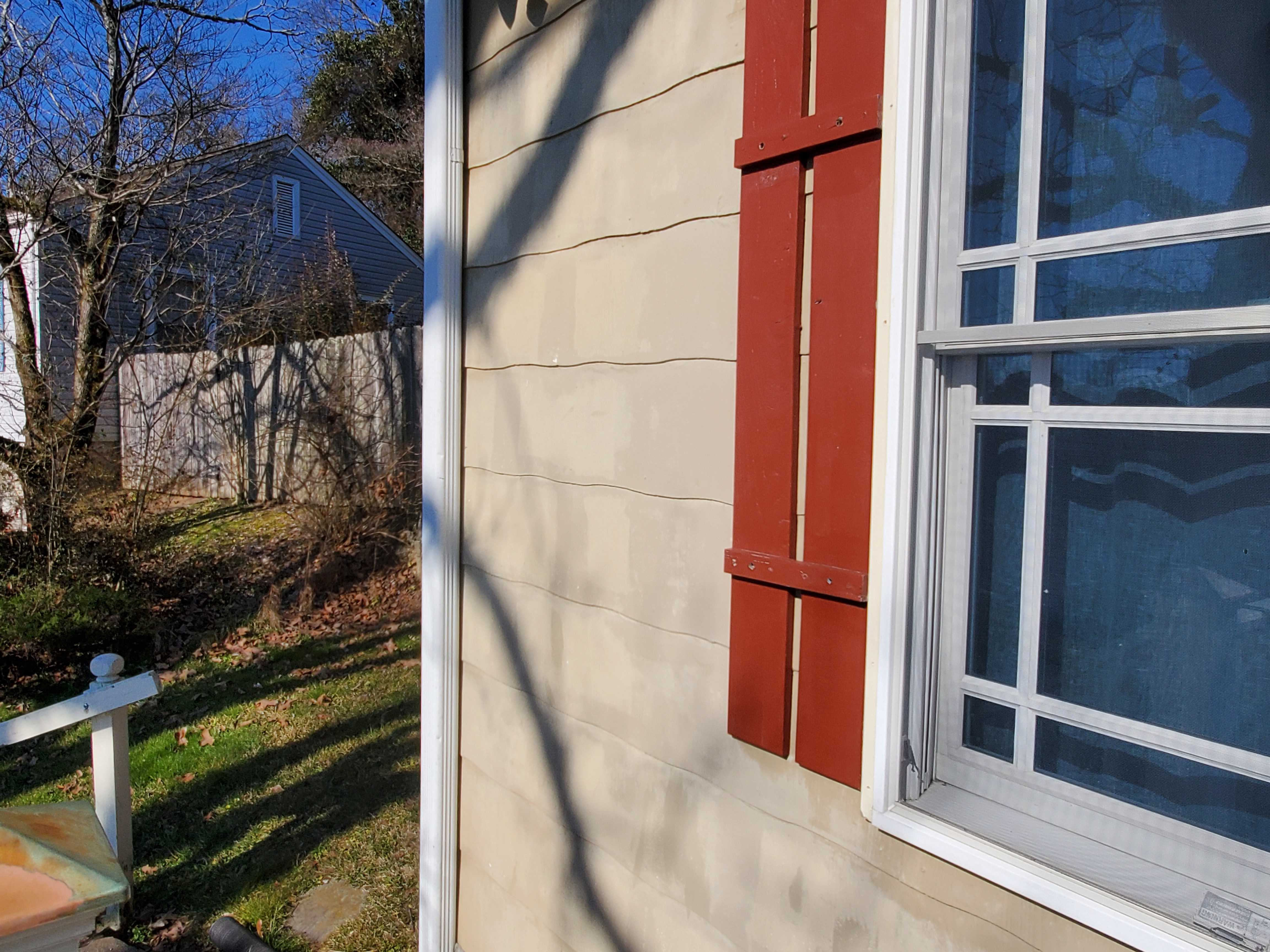
What to look out for in asbestos siding in good condition:
This photo below shows asbestos-cement siding with the characteristic look of "wood grain" shingles. At 87 years old, it remains in good condition.
- Uniform surface with no crumbling or chalky residue
- Intact edges and corners
- Painted or sealed surface layer
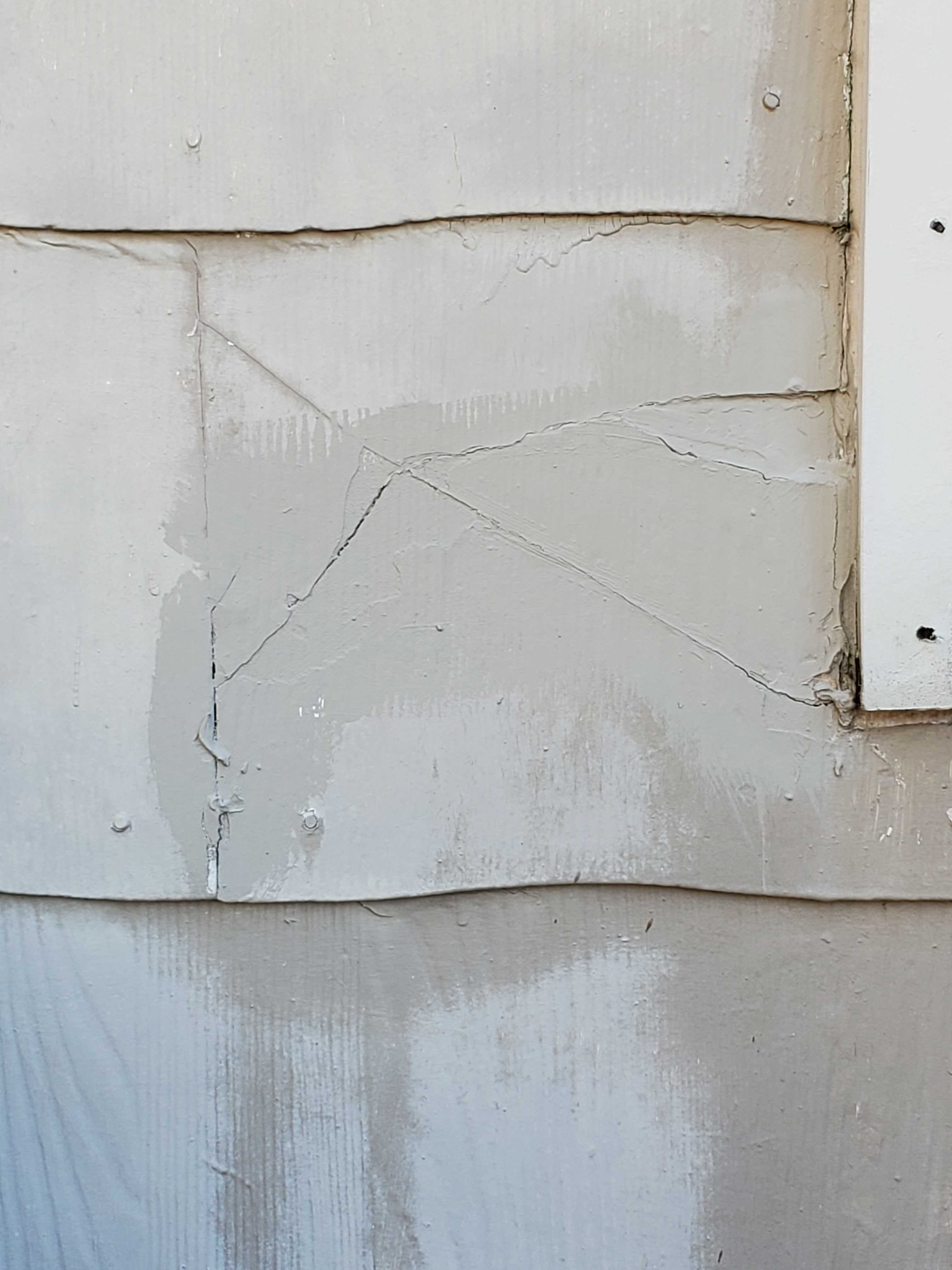
What to look out for in damaged asbestos siding:
- Cracks or chips near windows and doors
- Broken edges that may be painted or sealed over
- Brittle material that snaps rather than bends
Is asbestos siding safe?
Yes, when it’s intact. The risk increases when it’s disturbed. Asbestos-cement siding is a cement-bonded material that’s generally non-friable, meaning it doesn’t easily crumble or release fibers under normal conditions. Asbestos-cement siding can last for decades when it’s intact and well-maintained — but durability varies based on climate, paint/sealant upkeep, and installation quality. However, asbestos-containing stucco is more friable and can disintegrate into dust more easily than cement boards.
Health concerns arise when asbestos siding is cut, drilled, sanded, broken, or aggressively cleaned, which can release fibers into the air. Inhalation of these fibers is associated with serious health conditions such as asbestosis, lung cancer, and mesothelioma.[4]
Exposure is most likely during renovations, repairs, or demolition, not from simply living in the home.
It may be tempting to remove all traces of asbestos in the property, but if asbestos siding is in good condition, the EPA recommends leaving it alone.
Here are some dos and don'ts:
- Don’t drill, sand, saw, or pressure-wash asbestos siding
- Do keep it painted or sealed to prevent deterioration
- Do repair cracked or broken shingles using safe, professional methods
How common is asbestos siding?
Asbestos siding is still fairly common, especially in older homes. Houses built before 1990 contain some form of asbestos, and many of those homes used cement-bond siding. Homes built after 1990 are less likely to contain asbestos siding because the material is heavily regulated by the EPA.
For buyers, the age of the home is the biggest clue. If a house was built between the early 1900s and the late 1980s, asbestos siding is a possibility but not a certainty. Even during asbestos’ peak use, not all cement siding contained asbestos. Some manufacturers produced cement shingles without it, meaning appearance alone isn’t enough to confirm that a home has asbestos siding.
Asbestos use in new products is highly regulated in the U.S., and asbestos-containing building products are far less common today than in mid-century construction. If you’re buying a home, cement siding on an older home doesn’t automatically mean it’s made with asbestos, and the only way to know for sure is professional testing.
How to tell if siding contains asbestos
You can't identify asbestos by sight alone. While cement siding on pre-1990 homes has a strong likelihood of containing asbestos, not all manufacturers added it to their products. The only way to know is to get professional testing.
Real estate agents familiar with local housing stock can often advise on the likely presence of asbestos in older homes. Clever Real Estate expert Steve Nicastro recommends that homes built before 1990 be checked for environmental hazards, including asbestos, lead paint, and mold.
"If you're concerned," he says, "ask your property inspector to check specifically for that issue. If asbestos is suspected, they might recommend a specialist come out and do a more thorough inspection and offer guidance about remediation."
If you’re under contract:
- Ask your home inspector to note any materials that appear to be asbestos-containing.
- Order a lab test or asbestos inspection if siding is suspected.
- Get one or two quotes for encapsulation, covering, or abatement.
- Use those numbers to negotiate repairs, seller credit, or price.
🤔 How much does asbestos testing cost?
- A full asbestos inspection ranges from $231–$776, including the cost of sampling and testing.
- Adding an asbestos inspection to a general home inspection will run you about $330.
- DIY asbestos testing kits are available online for as little as $30. However, you should exercise extreme caution to avoid asbestos exposure when using this approach.
Source: HomeAdvisor
The EPA strongly discourages DIY sampling. Collecting samples yourself risks releasing fibers into the air. Let a certified professional handle it.
Does a seller have to disclose asbestos siding?
No federal law specifically requires asbestos disclosure, but many states have disclosure laws mandating that sellers reveal known material defects and hazards, including asbestos.
As Nicastro puts it, “The seller has to disclose pretty much every major issue or defect known to them on the disclosure form. That includes environmental problems like mold or asbestos. If they have it and know they have it, they have to disclose it."
Also keep in mind that disclosure is not the same as remediation. A seller can disclose asbestos and still sell the home as-is.
Does asbestos siding need to be removed?
No. In many cases, the safest option is to leave asbestos siding alone, especially when it’s intact and there are no renovation plans. Asbestos becomes a concern only when fibers are released into the air, which is why unnecessary removal can actually increase risk.
These tips will help you make an informed decision:
- If the siding is intact and no exterior renovations are planned: Leave it in place and maintain it.
- If there’s minor damage (small cracks or isolated broken shingles): Repair or encapsulate the affected areas.
- If there’s major damage or a renovation is planned: Hire a state-certified asbestos abatement contractor to handle removal.
Repair options and costs
| Cost per square foot | Total cost for 1,500 square feet | |
|---|---|---|
| Encapsulate with sealant | $2-6 | $3,000-9,000 |
| Cover with other siding | $5-12 | $7,500-18,000 |
| Remove | $8-12 | $12,000-18,000 |
| Remove and replace | $12-20 | $18,000-30,000 |
Source: HomeAdvisor
Factors that drive cost:
- Total exterior square footage: Larger homes cost more to seal, cover, or remove.
- Height and access: Multi-story homes and hard-to-reach areas raise labor costs.
- Disposal requirements: Fees vary by state and approved asbestos waste facilities.
- Local labor rates: Costs are higher in high-cost metro areas.
- Scope of work: Removing siding alone is cheaper than removing siding plus repairing damaged sheathing underneath.
Encapsulation ($2-6 per sq. ft.)
Encapsulation is often the safest and least expensive option. Contractors apply a specialized sealant designed to lock fibers in place without disturbing the siding. It’s typically about half the cost of removal, but it’s not permanent. Even sealed shingles can eventually dry out and crack with age.
Covering asbestos siding ($5-12 per sq. ft.)
Covering asbestos siding involves adding insulation or a vapor barrier, then installing new siding (vinyl, fiber cement, wood, or metal) over the original material. It’s more durable than encapsulation and still lower risk than removal, but improper installation can crack the siding underneath.
Removal or removal and replacement ($8-20 per sq. ft.)
Removing asbestos is the most expensive route and should be handled only by licensed asbestos professionals. While it’s the only permanent solution, it involves strict containment, disposal, and inspection requirements, which is why the cost is high.
🤔 Should you use the same company for inspection and removal?
To avoid a potential conflict of interest, consider hiring a different company to do the asbestos pre-inspection before the start of any removal or repair work. Some homeowners are surprised to find that what they thought was asbestos siding contains no asbestos at all.
Resale value and negotiation strategy
Homes with asbestos siding don’t automatically sell for less, but they can affect buyer demand and negotiations. Some buyers are uneasy about asbestos anywhere on a property, while others expect a credit to accommodate future management costs.
In markets with older housing stock, asbestos siding is often seen as a known issue rather than a dealbreaker, especially when it’s intact. One of the biggest concerns is the condition.
If you’re planning to buy a home in such markets, here are tips to negotiate:
- Ask for a seller credit vs. a price reduction: Seller credits preserve your cash for repairs. A price reduction lowers your loan amount but doesn't help with upfront costs.
- Use contractor quotes: Get 1–2 estimates for encapsulation, coverage, or removal, then present them during negotiations.
- Avoid demanding seller removal unless damage is severe: Many buyers prefer a credit so they can choose the contractor and control the scope of the renovations.
Knowing when to walk away is also important. Consider this route if:
- Major renovation is needed and siding shows widespread damage
- Your budget can't absorb management costs (even with concessions)
- Local regulations require full removal before you can proceed with planned work
A local real estate agent can tell you what credits are realistic in your market and how asbestos affects resale locally.
Financing and insurance
Will a bank finance a house with asbestos siding? Yes, in most cases. Lenders typically approve mortgages for homes with asbestos siding as long as the material is intact and doesn't pose an immediate safety hazard.
Issues arise when:
- The appraisal flags the siding as a safety or condition concern (widespread damage, deterioration)
- The lender requires repairs before closing to meet underwriting standards
- FHA or VA loans are involved (these programs have stricter property condition requirements)
If the appraiser notes asbestos-related concerns, you may need to address them through repair, encapsulation, or seller concessions before the loan can close.
Most policies treat asbestos abatement as maintenance and won’t cover elective removal. If asbestos-containing materials are damaged by a covered event, some policies may cover related removal/cleanup as part of the repair claim — confirm with your carrier.
Can you remove asbestos siding yourself?
In some areas, homeowners may be allowed to remove asbestos siding themselves, but rules vary by state and locality, and safe containment and disposal are often the biggest hurdles. Many agencies recommend hiring a licensed professional.
Depending on your location, you may be required to:
- Order a pre-inspection by a certified asbestos inspector
- Submit a notice of intent and pay a fee based on project scope
- Follow posted procedures for safe removal and containment
- Wrap and seal debris in approved containers
- Dispose of waste at an approved asbestos landfill (you cannot use regular trash)
The EPA and Consumer Product Safety Commission strongly recommend hiring a professional, even for small jobs.
⚠️ Caution
Be mindful of the dangers of inhaling asbestos fibers during or after DIY removal, and strongly consider hiring an asbestos-certified contractor to do the job. Professional help may be costly, but it’s well worth avoiding a potentially serious risk to your health.
Bottom line: Should you buy a home with asbestos siding?
A home with asbestos siding can be a smart buy, but only under the right conditions. Use this framework to decide quickly.
Buy it if:
- The siding is intact, painted, and well-maintained
- You don’t plan major exterior renovations anytime soon
- The price reflects the home’s age and condition, or you’ve negotiated a credit
Proceed carefully if:
- There are minor cracks or isolated damage that can be repaired or encapsulated
- You're planning renovations within five years that could disturb the siding
- The seller won't provide inspection records or disclosure details
Skip it if:
- The siding shows widespread breakage, crumbling, or dust
- Major exterior renovation is required immediately and your budget is tight
- Local regulations mandate full removal before you can proceed with planned work
Find an agent experienced with older homes and inspection negotiations. They'll help you assess risk, connect you with qualified inspectors, structure smart offers, and negotiate credits.
FAQ
Is it safe to live in a house that has asbestos siding?
Yes, as long as the material isn’t disturbed and the asbestos fibers stay contained within the cement, asbestos siding is safe. Asbestos siding can remain in perfect condition for 50 to 80 years or more.
How much does asbestos siding removal cost?
Removal typically costs $8 to $12 per square foot, with higher costs if replacement is included. Final pricing depends on home size, access, disposal rules, and local labor rates.
Is asbestos siding removal covered by insurance?
No, because insurance companies treat it as a maintenance expense. However, removal may be covered if the siding is damaged by a covered peril like a hurricane, fire, or storm.
Can you put vinyl siding over asbestos siding?
Yes, covering asbestos siding is often safer and cheaper than removal. It will typically cost $7,500 to $18,000 depending on the scope and size of the project.
Does asbestos siding affect resale value?
It may reduce the buyer pool, but it doesn’t always lower prices, especially in markets where older homes are common. Others may request a price reduction or walk away due to perceived risk.
How long does asbestos siding last?
Asbestos siding can remain intact for 50–80 years or more due to its durability. Encapsulating it with fresh paint or sealant can extend its lifespan even further.
Will a bank finance a house with asbestos siding?
Yes. Financing issues arise only if inspections or appraisals flag safety or condition problems that require repairs before closing.
Is it hard to sell a house with asbestos siding?
Not necessarily. In areas with older housing stock, intact asbestos siding is common, and buyers expect it. If the siding is damaged or poorly maintained, you may face a smaller buyer pool or need to offer concessions.
Should I be worried about asbestos siding?
Only if it's damaged, deteriorating, or you're planning renovations that require cutting, drilling, or removing it. Intact siding left undisturbed is generally safe.
Do you have to disclose asbestos when selling a house?
In most states, yes. Sellers must disclose known material defects and hazards, including asbestos.