
You've probably got a few home search apps open right now, and they mostly show the same houses. The real question isn't which site has the listings. It's which one you can trust, how fast it updates, and what happens when you tap "Contact Agent."
Nearly every site in this rundown pulls from the same source: the multiple listing service, or MLS, the database local agents use to post homes for sale. That shared feed is why Zillow, Realtor.com, and Redfin look so alike. What separates them is how quickly a status change lands, which listing details they get wrong, and where each one routes your inquiry.
The stakes are bigger than they look. In its most recent survey, the National Association of Realtors found that 52% of buyers found the home they purchased online and 70% searched on a phone or tablet, yet 88% still bought through an agent or broker.[1] The site finds the house; a person closes it. Both matter, and knowing what each one does well saves you time and a couple of expensive surprises.
How we picked these sites: We ranked the top five on the things that actually differ between platforms — how much of the MLS each one carries, how fast a status change appears, whether for-sale-by-owner homes are included, and where your inquiry goes when you tap Contact Agent. Traffic figures come from Semrush's June 2026 U.S. real estate rankings and each company's own reported metrics. We also interviewed three practicing agents, including a former Zillow Premier Agent, about what these platforms look like from the back end.
🔍 Just looking for a top-rated agent? Clever offers a free service that connects you with your area's best real estate agents, partnering with companies like Keller Williams and RE/MAX. You'll also get instant MLS alerts, on-demand showings, and expert negotiation. Fill out this short quiz to get matched with top-rated agents today!
Top 5 real estate sites for house hunting in 2026
| Site | FSBO listings | Where "Contact Agent" sends you | Standout feature |
| Zillow | Yes | A Premier Agent who paid for that ZIP code | Largest audience; draw-your-own-boundary map search |
| Realtor.com | No | The listing agent | Deepest per-listing data — schools, crime, commute — plus an affordability calculator |
| Redfin | No | A salaried Redfin employee agent | Compete Score, days-on-market and sold-comp filters, Sign & Save rebate |
| Homes.com | Some | The listing agent ("my listing, my lead") | Neighborhood video tours and insights on 20,000+ areas |
| Trulia | Yes — same feed as Zillow | Zillow's lead system | Trulia Neighborhoods: resident reviews, drone footage, lifestyle filters |
1. Zillow
Pros
- Most visited real estate website
- Features FSBO listings
- Intuitive mobile app
Cons
- Not always up-to-date
- Home value estimates can be inaccurate
- Not a great way to find a realtor
🔑 Key takeaway: Zillow provides a convenient and comprehensive starting point for your home search. Just remember to pair it with the expertise of a local real estate agent who understands the market and can guide you through making an informed offer.
Zillow stands out as the go-to site for house hunting. It offers a free, easy way to explore property listings in their desired area. Buyers can filter searches by location, price, home type, features, and more. The map view is a big part of why people keep coming back; you can draw a boundary around the exact blocks you want and see only what's inside it.
Zillow also estimates monthly costs, including mortgage fees, insurance, and property taxes, and provides neighborhood insights such as local schools, commute times, and walkability scores.
For buyers eyeing specific properties, Zillow’s app offers push notifications for updates on market changes. Additionally, you can connect with mortgage professionals through its network of lenders.
One of Zillow’s standout features is its proprietary “Zestimate,” which estimates a home’s value based on recent sales and appreciation trends in the area. While it can be a helpful reference point, it’s important to remember that the Zestimate is just an estimate, and can be off by thousands of dollars.
One place Zillow can quietly work against you is finding an agent. That prominent "Contact Agent" button usually doesn't reach the listing agent. It creates a lead that routes to a Zillow Premier Agent who paid for visibility in that ZIP code, and if that agent doesn't respond fast enough, it can pass to the next one who paid. The listing agent's name is usually on the page, just in small plain text most buyers never notice.
Dani Cabrera, a team leader at All Elite Homes in Fresno, California, and a former Zillow Premier Agent, watched this from the inside. When she was paying for those leads, buyers would reach her with detailed questions about a specific home, certain they were talking to the person selling it. In reality she was a buyer's agent who had paid to receive inquiries in that market.
As Cabrera puts it, the agent who marketed the home may never learn a buyer was interested, because the inquiry goes to whoever paid for the opportunity. It's also why matching with an agent through a vetted service, rather than a listing button, changes who's really working for you.
Zillow's other weak spot is freshness. A home that already sold or had an offer accepted and is pending sale can sit there for days, looking available. How frequently that happens depends on your market and the local MLS feed. Often the delay isn't even Zillow's: a home goes under contract on Tuesday, and the listing agent doesn't update the MLS until Thursday, and every site pulls from that same lagging record. The fix is simple. Have your agent set up instant MLS alerts on your criteria so you hear about a new listing the moment it hits the MLS instead of refreshing the app and hoping.
Zillow added First Street's climate risk data to for-sale listings in September 2024, then pulled the numerical scores off listing pages in late 2025 after several MLSs disputed the projections and agents said the scores were costing them sales.[2] [3] Under Zillow's December 2025 update, listings still carry a climate risk section, but it links out to First Street's site for the property-level flood, wildfire, wind, heat, and air quality scores rather than showing them inline. FEMA flood zone data and the map risk layers remain on Zillow directly. If climate risk matters to your search, pull the First Street report for the address yourself, and note that Redfin kept its climate data on-listing after Zillow removed its own.[4]
Clever offers more than just listings
While Zillow is great for browsing homes, Clever Real Estate goes further by providing up-to-date, fact-checked guides that walk you through every step of buying a home. You can get data-backed insights on closing costs and commission rates, and tips on how to earn home buyer rebates or cash back on your purchase.
2. Realtor.com
Pros
- Operates under NAR's REALTOR® trademark license
- Includes 99% of all MLS-listed properties nationwide
Cons
- Fewer FSBO listings than other sites
- App can be glitchy and difficult to use
🔑 Key takeaway: Realtor.com is a top choice for home buyers due to its credibility and extensive MLS coverage, but it lacks FSBO listings and has a less reliable app experience.
Realtor.com is operated by Move, Inc., a News Corp subsidiary, under a perpetual license to the Realtor.com name and the Realtor trademark from the National Association of Realtors. NAR licenses the brand; it doesn't own or run the site.[5]
Realtor.com is one of the most-visited real estate sites in the country, though not the second. By Semrush's June 2026 U.S. real estate rankings, Zillow led with about 227.9 million monthly visits, Craigslist came second with about 136.2 million (mostly rentals), and Realtor.com drew about 82 million.[6] The metric matters here, because "visits," "unique visitors," and "page views" are three different things.
Like Zillow, it allows you to research homes for sale in your area. However, what sets Realtor.com apart is its attention to detailed statistics and data. You'll find deep data on each listing: neighborhood and regional market trends, school ratings, local businesses, crime and commute times, and the site's own home-value estimate. Treat that estimate as a starting point, not a number to bank on; like every automated valuation, it can be off.
One field to check yourself is HOA dues. They're entered inconsistently across listings and sometimes missing entirely, especially for townhomes.
HOA dues count toward your monthly housing obligation, so a wrong or missing figure can change how much you qualify to borrow, either blindsiding you at underwriting or pushing you to skip a home that was in your budget all along. Alex Hubler, a real estate professional with JPW Realty in the Twin Cities who has a decade of experience, tells buyers that square footage and HOA dues are the two fields to verify independently. "Reviewing the HOA documents in detail is the only reliable way to know what the dues are, what they cover, and the rules," Hubler says.
Regular users lean on the street-view and property-lines tab, as well as the option to sort by recent price cuts to surface motivated sellers.
The platform also provides additional support with tips on buying a home, calculating mortgage payments, and determining your budget based on affordability.
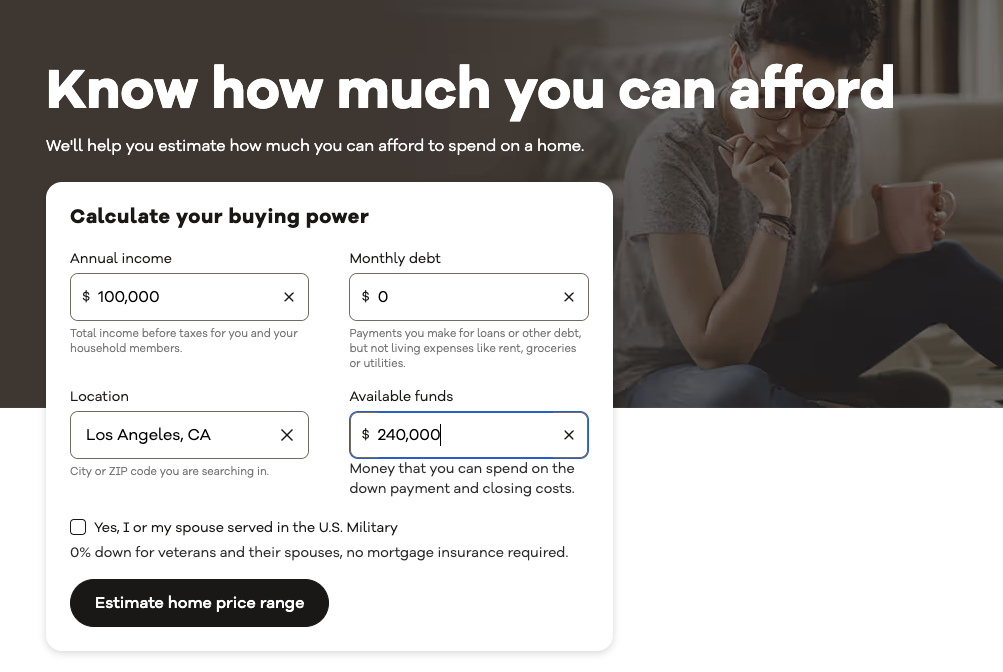
Despite its strengths, Realtor.com's one limitation is its exclusive focus on MLS-listed properties. Homeowners can't manually add FSBO listings to Realtor.com.[7] Only listings entered into an MLS by a licensed agent can be displayed, and basic MLS data and up to 100 images are free.
3. Redfin
Pros
- Direct MLS data for up-to-date listings
- "Redfin Sign & Save" cashback incentive
- Detailed market insights with Redfin Compete Score
Cons
- Limited to areas with Redfin agents
- Fewer listings than Zillow (no FSBO homes)
🔑 Key takeaway: Redfin is a great option for buyers seeking comprehensive home search tools and a cash rebate. However, it's limited to areas with Redfin agents, so consider alternatives like Zillow or Realtor.com for broader coverage.
Redfin is a real estate brokerage with licensed agents, but it’s best known for its popular home search website.
Redfin also works differently from Zillow on the agent side. Instead of routing you to whoever bought the lead in your ZIP code, Redfin uses mostly salaried employee agents. That cuts out the lead-auction roulette. The trade-off is that a salaried agent may not have the same street-by-street or price-band familiarity as a longtime local specialist.
Buyers also single out Redfin's filters for days on market and sold comparables, which make it easier to spot a stale listing or gauge what similar homes really closed at.
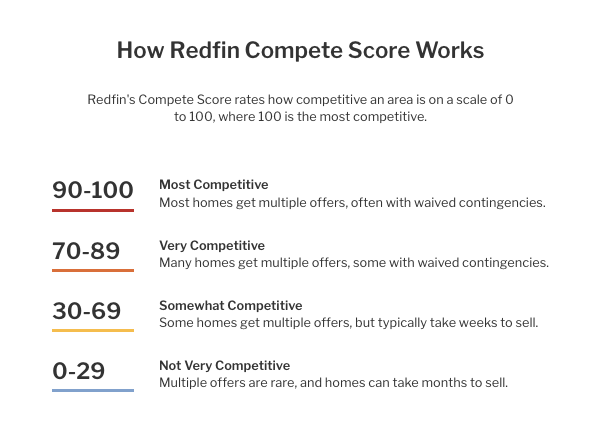
For the most part, you’ll find the same listings on Redfin as on other major real estate sites, but Redfin includes unique features like the Redfin Compete Score, which shows how competitive the local market is based on whether homes are selling above or below their list price.[8] Additionally, buyers can receive push notifications for new listings in their favorite neighborhoods.
On estimate accuracy, Redfin publishes a median error rate of about 2.1% for on-market homes against Zillow's roughly 2.4%, and about 6.5% versus 7.5% for off-market homes.[10] Both are starting points, not appraisals — the gap between them is smaller than the gap between either one and what a home actually sells for.
One of Redfin’s standout offerings is its rebate program, now called Redfin Sign & Save. Redfin’s Sign & Save pays back 0.25% of the purchase price at closing if you sign a buyer agency agreement with a Redfin agent before your second tour and go under contract within 180 days. On a $400,000 home, that's $1,000 back. For higher-end homes purchased through Redfin Premier, the rebate doubles to 0.5%; applied to a $400,000 price that would be $2,000, though Premier is aimed at luxury purchases rather than a mid-market home like this one.[11] The rebate isn't available everywhere; a handful of states prohibit commission rebates by law, so confirm your state on Redfin's current terms before counting on it.[12] These terms have shifted before, too. Redfin zeroed out its earlier buyer refund in 2022 and relaunched later, so verify the current offer at redfin.com rather than assuming it matches what you read months ago.
This program aligns with recent NAR settlement changes, which now require buyers to sign a buyer agency agreement with their agent before viewing properties.[13] Essentially, Redfin adds a cash incentive to a practice buyers would already need to follow.
Additionally, Redfin offers a 1% listing fee when you both sell and buy a home using a Redfin agent. To qualify, you must buy with Redfin within 365 days of closing on your Redfin listing.[14]
Redfin is now part of Rocket. Rocket Companies completed its acquisition of Redfin on July 1, 2025, an all-stock deal valued at about $1.75 billion, making Redfin a wholly owned Rocket subsidiary that now operates as "Redfin Powered by Rocket."[15] At closing, the companies rolled out Rocket Preferred Pricing: buyers who finance with Rocket Mortgage and buy a home listed by (or found with) a Redfin agent can take either a one-percentage-point interest-rate reduction for the first year or a lender credit at closing of up to $6,000.[16] A first-year rate cut tied to one lender is real savings and a real steering incentive, so it's worth weighing both sides before you commit to the bundle.
4. Homes.com
Pros
- Good neighborhood insights
- Innovative snap and search tool
- Tons of agent profiles
Cons
- Negative agent feedback
- App can be hard to navigate
🔑 Key takeaway: Homes.com is a fast-growing platform with strong neighborhood insights and innovative tools. However, agents’ complaints about lead quality, customer service, and navigation issues could impact your experience.
Homes.com, owned by CoStar Group, is a home search platform that gathers data from MLS and other real estate sites. It’s designed to easily compare homes and offers insights into property value trends, helping buyers understand potential appreciation in a neighborhood.
Homes.com has been exploding in popularity. Its “my listing, my lead” policy directs all leads generated from a listing back to the listing agent, unlike competitors like Zillow that sell these leads. This Realtor-friendly model, backed by a marketing investment CoStar has estimated at more than $1 billion, has fueled fast growth. CoStar reported the Homes.com network reached about 108 million average monthly unique visitors and 2.1 billion views in 2025, second among U.S. residential portals behind Zillow.[17]
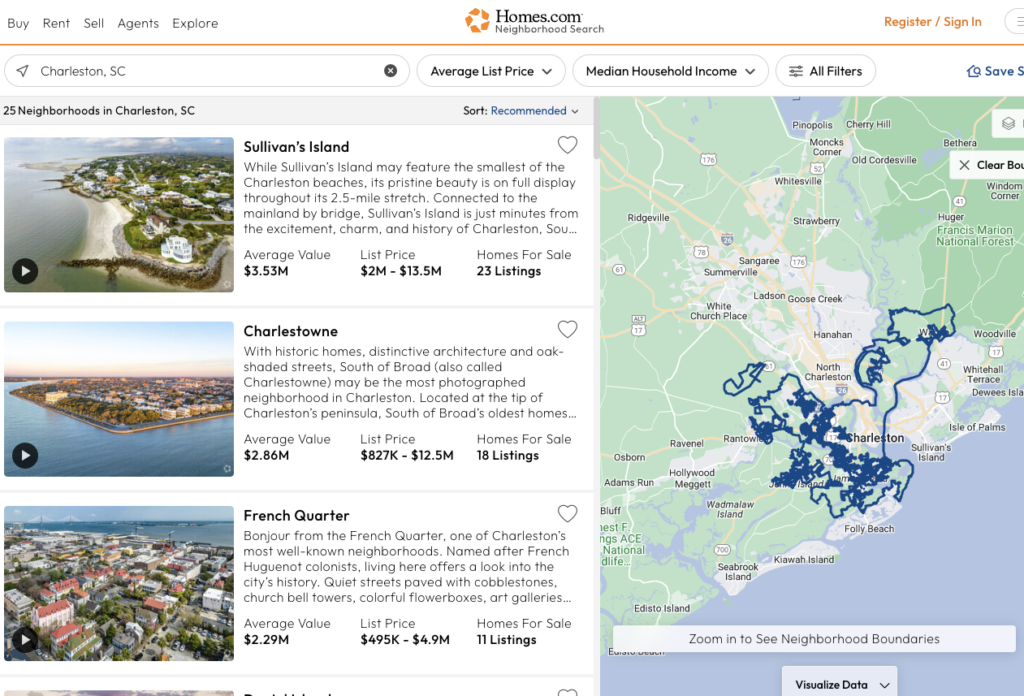
One key feature for buyers is its neighborhood feature, which provides the following benefits:
- Video tours.
- In-depth articles, and insights on over 20,000 neighborhoods.
- Insights on top-rated schools with expert reviews.
- The ability to search condo buildings using detailed filters.
- Over a million agent profiles that include bios, photos, reviews, and deal histories.
The main downside to Homes.com is the negative feedback from agents reporting poor-quality leads, which are described as spam or contain inaccurate contact information. Across agent reviews on Consumer Affairs and Trustpilot, recurring complaints include misleading contract terms, unresponsive customer service, and unmet advertising promises.
While these issues don't directly impact home buyers, they could influence your overall experience with the platform.
5. Trulia
Pros
- Owned by Zillow (identical listings)
- Features detailed neighborhood info
Cons
- No home values for on-market listings
- Monthly payment estimates can be inaccurate
🔑 Key takeaway: Despite its strengths, Trulia draws significantly less traffic than Zillow or Realtor.com. However, its emphasis on neighborhood details and visual tools makes it a valuable resource for buyers looking to understand a community before moving.
Trulia is owned by Zillow and shows the same listings from the same feeds, so you're choosing an interface, not a different set of homes. Pick Trulia when its neighborhood and lifestyle view helps you picture living somewhere, not because you expect to find a house here that isn't on Zillow.
Trulia is a user-friendly platform that helps you find and compare homes easily, similar to other popular home browsing tools. You can search by various factors, such as the number of bedrooms, price range, and home type.
Both the Trulia website and app are intuitive, offering a general overview of surrounding neighborhoods and nearby properties.
One standout feature is Trulia Neighborhoods, which gives you an immersive look into everyday life in a community. This feature includes original photos, drone footage, user-generated reviews from residents, and local insights to help you decide if a home and neighborhood fit your needs.
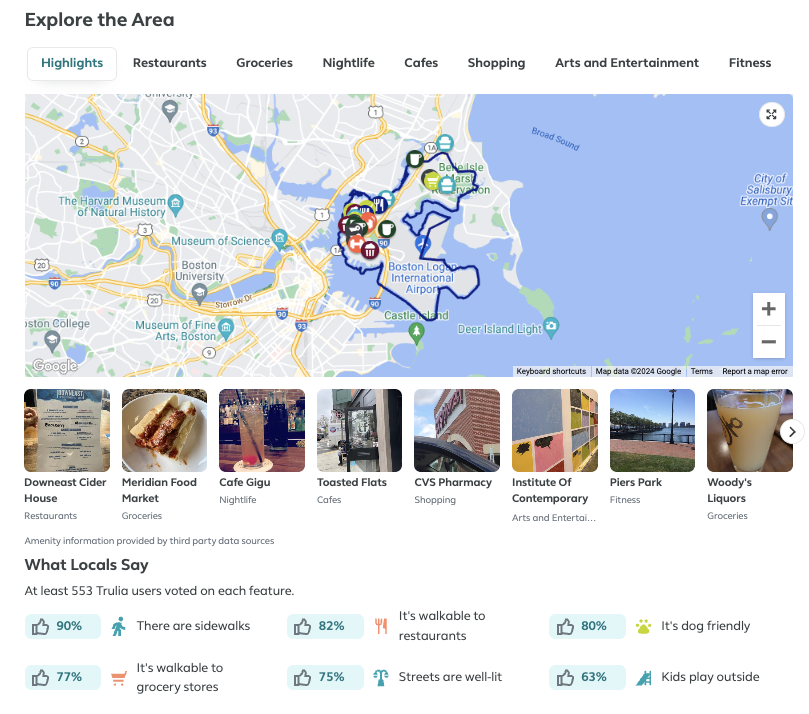
The interactive map lets you explore different filters, such as the crime filter to identify safe areas. Additional filters cover commute times, nearby schools, median age ranges, home affordability scores, and the locations of restaurants and shops.
So which one should you actually use?
Use two, not five. Pick Zillow or Realtor.com as your primary — Zillow if you want FSBO homes in the mix, Realtor.com if you want the deepest data on each listing — and add Homes.com or Trulia while you're still deciding on neighborhoods. If you're in a Redfin market and haven't signed with an agent yet, run Redfin in parallel for the rebate and the sold-comp filters.
Then do the thing that matters more than the site you chose: ask your agent to set up an MLS alert on your exact criteria. That alert fires when a home hits the MLS, which is hours to days before it reliably appears on any of these sites. No app refresh beats it.
Other top real estate sites for buyers
HomeFinder
HomeFinder is a good choice for finding hidden FSBO gems. It offers tools to refine your search and discover properties not listed elsewhere.
HomeFinder offers a huge selection of homes to buy or rent and interesting categories such as "off market" properties. It functions similarly to Zillow or Trulia, offering an interactive search tool that filters for price, size, and property type to connect you with the right home.
HomeFinder advertises FSBO listings alongside agent-listed homes. That means you could find exclusive properties on HomeFinder that aren’t listed on other popular real estate websites. If you like one, you can have your agent negotiate directly with the seller.
ForSaleByOwner.com
ForSaleByOwner.com helps buyers find FSBO deals, but be cautious about potential pricing risks and agent commission arrangements. Check out the best FSBO sites to find more for sale by owner homes, and take a look at our article on FSBO vs. realtor statistics to familiarize yourself with FSBO home purchases.
ForSaleByOwner.com is one of the best real estate websites for finding homes not listed on the MLS. It has fewer listings than sites like Realtor.com, so it shouldn't be the only house-hunting tool you use.
However, it may include FSBO listings that don't appear on other websites, which could help you find homes that other local buyers may not know about.
FSBO often sell for less than market value — so you may be able to find a good deal. However, there are some issues to be aware of when you buy from a DIY seller. If the seller has overpriced their home, your lender will likely only approve your mortgage for the appraised value, which could cause complications during closing. Also, note that some FSBO sellers won't cover the buyer's agent commission. That matters more now than it used to. Since NAR's practice changes took effect in August 2024, you sign a buyer agency agreement spelling out your agent's fee before you tour, so if the seller doesn't chip in, that cost is yours to cover or to negotiate into the deal.[18]
Foreclosure.com
Foreclosure.com is ideal for those interested in buying distressed properties at lower prices and willing to invest in renovations.
If you're looking for a cheap house and aren't afraid of taking on some DIY home improvement projects, check out Foreclosure.com. This house buying website specializes in short sales, foreclosures, city-owned houses, and other distressed properties.
Most homes listed on Foreclosure.com require a lot of TLC, but you'll have less competition from other buyers, so you'll have a much better chance of finding a deal.
Auction.com
Auction.com is a clearinghouse for bank-owned and foreclosed properties, and opening bids are often set below a home's estimated resale value.
If you’re the only interested party, you’ll get a bargain. However, most properties on Auction.com have a reserve price — if no bid meets or exceeds that price, the auction will end without a buyer. Also, if a property attracts a lot of interest, a bidding war can often drive the price way up.
Sellers who auction their properties prioritize a fast home sale over a maximum price, and it’s a relatively expensive way to sell once you factor in auction fees. These motivated sellers translate to a lot of potential value for buyers. Just remember that auctions usually require a deposit soon after you win, so read the platform's terms before you bid.
Social platforms for finding FSBO homes
Craigslist
Craigslist ranks second among U.S. real estate sites by raw traffic, but most of that is rentals, which is why it sits here as a supplement rather than a top-five pick.[6]
Craigslist is a straightforward platform with basic search filters that gives users access to local FSBO listings and rental properties that may not be found on other websites.
While it's a simple way to explore local real estate options, users should be cautious about potential scams and always verify listings thoroughly.
Facebook Marketplace
Facebook Marketplace offers another way to find local FSBO listings and undeveloped land, with the added advantage that some sellers provide owner financing.
However, the platform has a more limited range of listings than major real estate sites, so it's best used as a supplementary tool for local deals.
Research tools to use alongside your home search
These aren't places to find listings. They're where you check what the listing pages won't tell you: school quality, block-level neighborhood data, and how a ZIP code actually compares to the one you're leaving.
Neighborhood Scout
Neighborhood Scout stands out for its in-depth data on neighborhood characteristics, offering block-by-block granularity for precise searches.
This platform is especially valuable for data-driven buyers who want detailed insights on neighborhoods and micro-communities, although its highly analytical approach may not appeal to everyone.
GreatSchools.org
This website provides comprehensive ratings and reviews of local schools, including metrics like test scores, college readiness, and teacher-to-student ratios. It’s an essential tool for families who prioritize quality education and understand long-term property value retention.
Niche
Like GreatSchools, Niche similarly offers data-based rankings for public, private, and charter schools. This information can help families make informed decisions about where to settle down.
However, users may still need to visit individual school websites for more detailed insights on district boundaries and enrollment procedures.
FAQ
Do I still pay my agent if I find the house myself on Zillow?
Usually, yes. Since NAR's practice changes took effect in August 2024, you sign a buyer agency agreement, fee included, before you tour homes, and that fee applies whether you found the house or your agent did.[18] Ryan Fitzgerald, owner of Raleigh Realty in Raleigh, North Carolina, says sellers still commonly cover that fee through a concession or credit, but it's negotiated deal by deal now, not assumed. On a $400,000 home, a 2.5% fee runs $10,000.
Why is a house still showing on Zillow after it sold?
Because the update has to travel. When a home goes under contract, the listing agent marks it pending in the local MLS, and that change then syndicates out to Zillow, Redfin, and everywhere else. Often the bigger delay is on the listing agent's end: the home went under contract Tuesday and the MLS wasn't updated until Thursday. Ask your agent to confirm status before you get attached.
What are the best home buying websites?
Some of the top real estate websites to explore include Zillow, Realtor.com, Redfin, Homes.com, and Trulia. Each platform offers unique features and resources to help you find properties, compare listings, and gain market insights. Start with these top picks and read our detailed reviews to find the best one for your needs.
Is Zillow or Redfin better?
For browsing, Zillow wins on coverage: it has the most listings and it shows for-sale-by-owner homes, which Redfin doesn't. Redfin's edge is money and market data. Its Sign & Save rebate pays 0.25% of the purchase price at closing, or $1,000 on a $400,000 home, and Redfin uses salaried agents rather than routing you to whoever bought the lead in your ZIP code.[11]
Is Realtor.com or Zillow more accurate?
It depends which kind of accuracy you mean. Both pull listings from the same MLS feeds, so status freshness comes down to your local market and how quickly the listing agent posts updates. For home-value estimates, each site publishes its own error rates; check those directly. For listing details like square footage and HOA dues, verify with your agent no matter which site you used.
What are the best MLS websites?
Zillow, Realtor.com, Redfin, Homes.com, and Trulia all pull from MLS feeds, so you're looking at largely the same inventory on each. Realtor.com connects to a large number of regional MLSs but shows only MLS-listed homes, which means it misses for-sale-by-owner properties. The freshest access isn't a public site at all. It's an agent-configured MLS alert that hits your inbox the moment a match lists.